
On this page
Quick answer: Three-way matching compares the purchase order, goods received note, and supplier invoice before payment. A match confirms that the item, accepted quantity, and invoiced price agree; a mismatch is held for review.
Most restaurants pay invoices as they come in. The invoice looks about right, the supplier is familiar, and the bill gets settled. The problem is that "about right" is not a check - it is an assumption.
What are the three documents in 3-way matching?
Three-way matching compares exactly three documents:
| Document | What it records | Who creates it |
|---|---|---|
| Purchase order (PO) | What was ordered, at what price, in what quantity | You, before the delivery |
| Goods received note (GRN) | What actually arrived, item by item | You, at the time of delivery |
| Supplier invoice | What the supplier is asking you to pay | The supplier, after delivery |
Each document is created independently. Three-way matching puts them side by side and flags every line where they disagree.
Three documents, one decision
Skip the step-by-step viewStep 1 of 5: Approve the order
The purchase order sets what you agreed to buy: the items, the quantities and the price per unit.
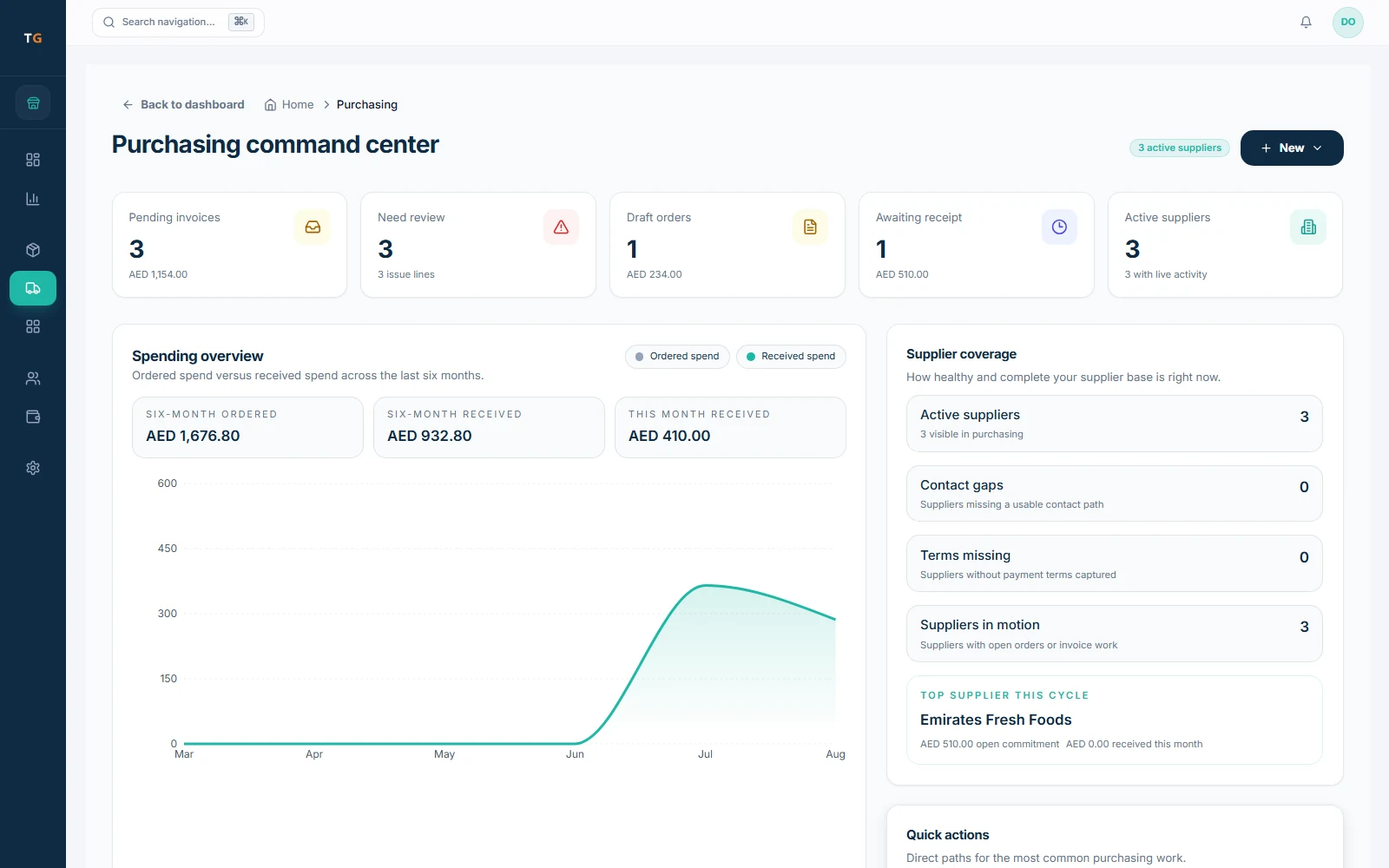
PO: tomatoes 12 kg at AED 4.50Worked example
Step 2 of 5: Check what arrived
At the back door, count and weigh the delivery against the order. Record what actually came in on the goods received note.
GRN: tomatoes 10 kg receivedWorked example
Step 3 of 5: Review the invoice
Supplier invoice lines are prepared for your team to review before anything is approved.
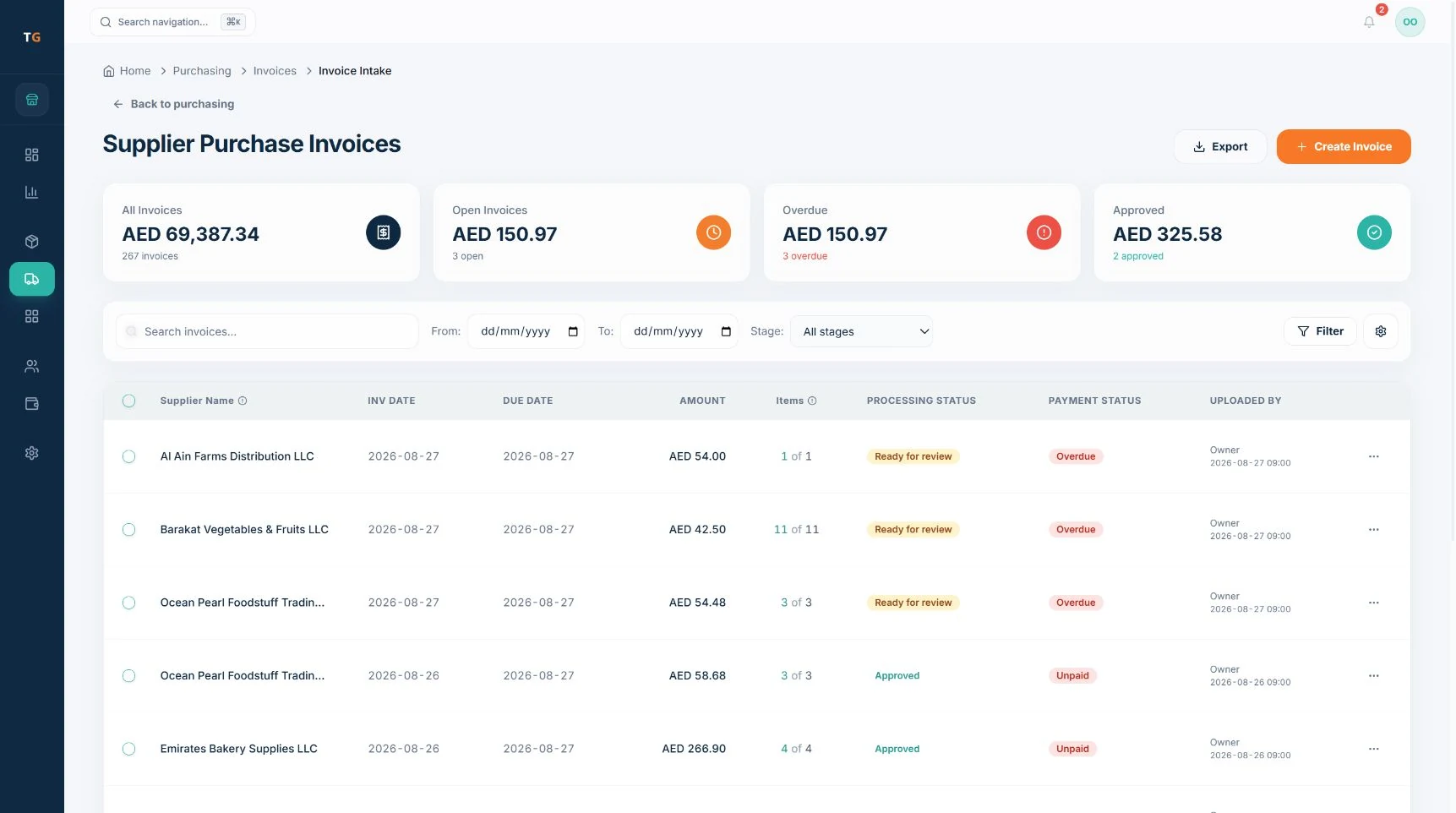
Invoice: ready for reviewDemonstration data
Step 4 of 5: Match line by line
Compare order, delivery and invoice for each item. A quantity, price or item difference stays open until someone resolves it with the supplier.
Invoiced 12 kg, received 10 kg: AED 9.00 differenceWorked example
Step 5 of 5: Pay for what you received
Approve the corrected invoice. Approved prices build the supplier price history, so the next invoice has something to be checked against.
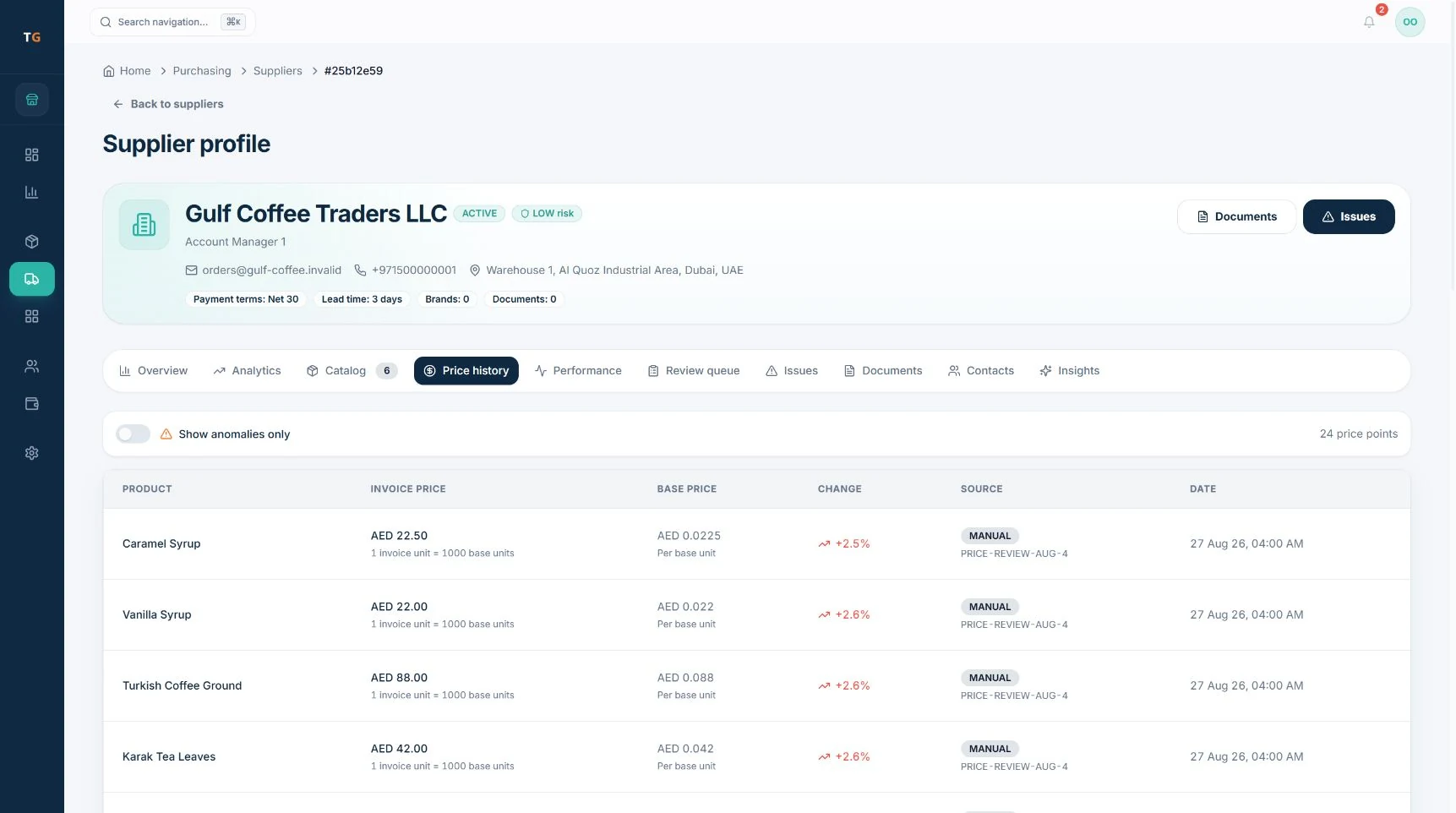
Price change: +2.6%Demonstration data
Product screens show demonstration data. Venue photos are illustrative.
Read the steps as text
Step 1: the purchase order records what you agreed to buy, the quantities and the prices. Step 2: when the delivery arrives, staff count and weigh it and record what actually came in on the goods received note. Step 3: the supplier invoice lines are prepared for your team to review. Step 4: match the three documents line by line; quantity, price or item differences stay open until someone resolves them, for example tomatoes invoiced at 12 kg but received at 10 kg. Step 5: approve and pay for what you received; approved prices build the supplier price history for the next check.
What does a 3-way match actually check?
The comparison has two axes: quantity and price.
Quantity axis:
- PO quantity vs. GRN quantity - did you receive everything you ordered?
- GRN quantity vs. invoice quantity - is the supplier invoicing for what was delivered, or for something different?
Price axis:
- PO unit price vs. invoice unit price - is the supplier charging what was agreed?
Any mismatch on either axis is a discrepancy that needs resolving before payment.
The four most common mismatches caught by 3-way matching:
| Mismatch | What it means |
|---|---|
| Invoice price higher than PO price | Supplier charged more than the agreed rate |
| Invoice quantity higher than GRN quantity | Supplier billed for more than was delivered |
| GRN quantity lower than PO quantity | Short delivery - you received less than you ordered |
| Item on invoice not on PO | Supplier added a line item you did not order |
None of these require bad faith from the supplier. Pricing system errors, picking mistakes, and billing delays all produce legitimate discrepancies. The point of 3-way matching is that they are caught and resolved before money moves.
Worked AED example: what should be held for review?
| Check | Purchase order | Goods received note | Supplier invoice | Result |
|---|---|---|---|---|
| Chicken quantity | 10 kg | 9 kg accepted | 10 kg billed | Hold the 1 kg difference |
| Unit price | AED 30/kg | Not a price document | AED 32/kg | Hold the AED 2/kg difference |
| Extended value | AED 300 ordered | AED 270 received at PO price | AED 320 billed | AED 50 requires resolution |
The invoice is not approved merely because its arithmetic is correct. The restaurant first confirms whether one kilogram was rejected, back-ordered, or omitted from the GRN, and whether the AED 32 price was authorised after the PO. The records provide a specific question for the supplier instead of a general invoice dispute. This is the control supported by a connected purchase-order and supplier workflow.
How much does skipping 3-way matching actually cost?
The cost is rarely one large event. It builds up from small discrepancies across many orders. A worked example:
- A restaurant ordering from five suppliers, three times a week each.
- Each order has an average of one small discrepancy: a unit price AED 0.50 higher per kg, or 1 kg short on a 20 kg delivery.
- Across 15 orders a week at an average AED 15 discrepancy, that is AED 225 a week.
- Over a year, that is over AED 11,000 - without any single event looking large enough to notice.
No single invoice looks alarming. The total is what hurts.
What is the difference between 2-way and 3-way matching?
2-way matching compares only the purchase order and the invoice. It catches price discrepancies but does not check whether the delivery actually matched the order. You could pay the correct price for 20 kg when only 18 kg arrived, and a 2-way match would pass it.
3-way matching adds the goods received note, checking that the quantity invoiced was also the quantity delivered. This is the check that catches short deliveries - the most common form of procurement loss in food service.
What needs to be in place for 3-way matching to work?
Three-way matching only works if the three documents all exist and are created at the right time:
- Purchase orders must be created before delivery - not retrospectively. A PO created after the goods arrive cannot be used to verify the delivery.
- GRNs must be recorded at the time of delivery - not from memory afterward. The physical check happens at the door; the record should be created then.
- Invoices must be compared against both - not just reviewed in isolation.
The process breaks if any of the three documents is missing or created out of sequence. This is why a system that links all three - creating the GRN against an open PO, then matching the invoice against both - is more reliable than a manual spreadsheet process.
Read next: Restaurant procurement UAE: the full guide (pillar) · How to create a purchase order for your restaurant · How to catch supplier overcharging before you pay · Goods received notes: the step most restaurants skip · Purchase orders and supplier management
Frequently asked questions
Does 3-way matching work for a small restaurant with just a few suppliers?
Yes - and for a small restaurant it is arguably more important. A larger operation has volume that absorbs individual discrepancies; a small restaurant operating on tight margins feels every AED lost to an unchecked invoice.
What do I do when a discrepancy is found?
Contact the supplier with the specific discrepancy: the PO price versus the invoice price, or the GRN quantity versus the invoice quantity. Most legitimate suppliers will issue a credit note or corrected invoice promptly. The record of the PO and GRN is your evidence.
Does 3-way matching require a system, or can it be done manually?
It can be done manually with spreadsheets, but it is error-prone and slow enough that most restaurants skip it when busy. A system that performs the match automatically - flagging discrepancies as part of normal invoice processing - removes the friction that leads to the process being bypassed.
What if a delivery arrives without a prior purchase order?
This is a common situation in restaurants that place informal orders. The practical fix is to create the PO immediately upon receiving the delivery (as a same-day record of what arrived and at what price), then process the invoice against that PO. It is less reliable than a pre-delivery PO, but it is better than no record at all.
About this guide. Maintained by the TajerGo Editorial Team. Last updated 26 Sep 2026. Worked examples use illustrative numbers, not customer results.