
On this page
- What does FIFO mean in a restaurant kitchen?
- Why does FIFO matter for food cost?
- How do you implement FIFO in a restaurant storage area?
- What labelling system works best for a restaurant kitchen?
- How does FIFO connect to inventory costing?
- How does batch and expiry tracking support FIFO?
- What is the connection between FIFO and stock variance?
- In the product
- Frequently asked questions
Quick answer: FIFO (first in, first out) means using older stock before newer stock - the simplest discipline a restaurant can adopt to cut spoilage and protect food cost. New deliveries go to the back; existing stock stays at the front and gets used first.
Without FIFO, older ingredients get buried, expire, and become waste you paid for but never sold.
Spoilage is a quiet, persistent cost. A kilogram of protein that expires unnoticed in the back of a walk-in costs the same as one you sold at full margin - except you get nothing for it.
What does FIFO mean in a restaurant kitchen?
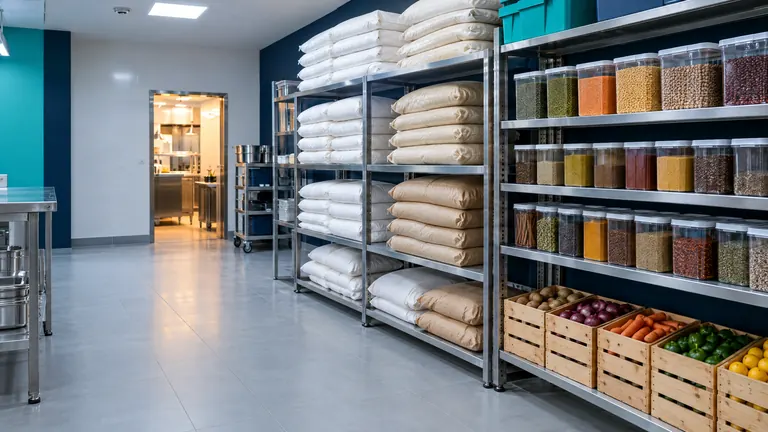
FIFO stands for first in, first out. It means the ingredient that arrived first gets used first. In a kitchen context, this is a physical practice - when a delivery arrives, new stock goes to the back or the bottom, and existing stock is pulled forward or to the top. The team always grabs from the front or the top, which is always the oldest stock.
The opposite - grabbing from wherever is closest - means newer stock often gets used while older stock sits at the back until it expires.
Why does FIFO matter for food cost?
Every item that expires unsold is money lost twice: you paid for it, and you still need to buy a replacement. In a restaurant that spends AED 40,000 per month on food, even 3% spoilage is AED 1,200 per month thrown away. FIFO does not eliminate all waste, but it eliminates the most preventable type - ingredients that expired only because they were buried behind newer stock.
| Impact of FIFO | Impact of no FIFO |
|---|---|
| Older stock used first; fewer expirations | Older stock buried; regular expiry losses |
| Predictable shelf-life for every item | Surprise discoveries of expired stock |
| Accurate inventory: oldest cost used first | Costing errors if older and newer batches have different prices |
| Easier to date-check during prep | Date checks often skipped because it is too much effort |
How do you implement FIFO in a restaurant storage area?
The rules are simple; the habit takes a few weeks to build:
Dry store:
- Shelving is organised so new deliveries are placed behind existing stock.
- Team always takes from the front.
- Use shelf labels: "FRONT = OLDEST. USE THIS FIRST."
Main fridge and prep fridges:
- New deliveries on the right, existing stock on the left.
- Always take from the left.
- Alternatively, stack vertically: new stock on top, old stock underneath.
Walk-in freezer:
- New deliveries to the back wall.
- Always pull from the front shelves.
Labels - the non-negotiable: Every item in storage should have a label showing at minimum the received date and, for prepped items, the prep date and discard date. Without labels, FIFO relies on memory - and memory fails at 2am on a busy Friday shift.
What labelling system works best for a restaurant kitchen?
A practical system needs three labels:
- Received date label - applied by the receiving team at delivery. Goes on every case, every container, every bag.
- Prep date and discard date label - applied when an ingredient is processed (broken down, marinated, portioned). Shows the date it was prepped and the date by which it must be used.
- Opened date label - applied when a sealed container (sauce, oil, seasoning) is first opened.
Colour-coded day-dot labels are widely available in UAE restaurant suppliers and cost almost nothing. Assign a colour to each day of the week so the kitchen team can spot the oldest items at a glance without reading a date.
How does FIFO connect to inventory costing?
FIFO is not just a physical practice - it is also a costing method. When you sell a dish, the system needs to decide: which cost do I record for the ingredients used? With FIFO costing, the system assigns the cost of the oldest batch first.
Why this matters: ingredient prices change. If you bought chicken at AED 28/kg last week and the new delivery is AED 31/kg, your COGS should reflect that you are still using the cheaper batch first. FIFO costing does this automatically. Weighted average costing blends all prices, which is simpler but less precise when prices are volatile.
TajerGo lets you choose between FIFO and weighted average costing per item in the stock settings, so the method matches how your business actually works.
How does batch and expiry tracking support FIFO?
Knowing FIFO matters is one thing; enforcing it when the walk-in has 200 items is another. Batch and expiry tracking gives the system visibility into which physical batches are on hand and when they expire - so it can flag items nearing their expiry date, prompting the team to prioritise them.
TajerGo tracks stock by batch with expiry dates and flags items nearing expiry, making it easier to catch a forgotten batch before it becomes wastage.
What is the connection between FIFO and stock variance?
When FIFO is not followed, older stock expires and gets discarded - often without being logged as wastage. This creates stock variance: your system shows you have 8 kg of something that you actually used up (some was sold, some expired and was thrown away without being recorded). The physical count then shows less than the system expects.
FIFO reduces this type of variance because less stock expires unnoticed. Variance that does remain after consistent FIFO practice is more likely to be a real signal - over-portioning, theft, or a delivery discrepancy - rather than background noise from rotation failures.
Read next: Restaurant inventory management UAE: the complete guide (pillar) · How to track wastage in a restaurant kitchen · Stock variance: what it means and how to investigate it
Frequently asked questions
What does FIFO stand for in a restaurant?
FIFO stands for first in, first out. It means the ingredient that arrived first is used first. In physical terms, new deliveries go to the back of the shelf or fridge, and the team always grabs from the front, where the oldest stock sits.
How does FIFO reduce food waste in a restaurant?
FIFO prevents older stock from being buried behind newer deliveries. Without FIFO, ingredients at the back are often forgotten until they have already expired. With FIFO, every item moves forward as new stock arrives, so nothing expires while newer stock is being used.
Is FIFO a costing method or a kitchen practice?
Both. As a kitchen practice it is about physical stock rotation. As a costing method it determines which batch cost is recorded when an ingredient is consumed in a sale. Most restaurant inventory systems, including TajerGo, let you select FIFO as the costing method so these two aspects stay aligned.
What is the easiest way to train kitchen staff on FIFO?
Label everything with received dates and use directional storage rules (new stock goes to the back, always grab from the front). Colour-coded day-dot labels make date-checking fast enough that staff will actually do it during busy prep periods.
Does FIFO affect my stock variance?
Yes. Poor FIFO is a common cause of unexplained stock variance because expired stock gets discarded without being logged as wastage. Consistent FIFO reduces this type of background variance, making the variance that remains easier to investigate.
About this guide. Maintained by the TajerGo Editorial Team. Last updated 22 Aug 2026. Worked examples use illustrative numbers, not customer results.