

On this page
- Why does UAE heat and humidity accelerate food spoilage?
- What is FIFO and why is it critical in UAE restaurants?
- What are the main causes of food waste in UAE restaurants?
- How does ordering to demand reduce food waste?
- How do temperature controls protect perishable stock?
- What does wastage tracking tell you about your business?
- In the product
- Frequently asked questions
Quick answer: The UAE's extreme heat and humidity accelerate food spoilage, so restaurants fight waste with strict FIFO rotation, temperature discipline, and inventory systems that flag stock before it expires.
Every perishable you bin is money already paid to a supplier that will never come back as a sale. In a UAE summer the safe window is shorter than most plans assume, so waste control has to be tighter than in cooler markets.
Why does UAE heat and humidity accelerate food spoilage?
Summer temperatures pass 40°C, and coastal humidity in Dubai and Abu Dhabi often runs above 80%. That changes the rules in four ways:
- Bacteria multiply fast above 5°C. A warm receiving bay, an open walk-in door or a trolley left in a corridor is enough.
- Humidity grows mould on bread, produce and exposed protein. Something that lasts four days in Europe may last two here.
- Temperature cycling hurts. Moving stock between the cold room and a hot kitchen degrades it even when each reading looks fine.
- Power cuts are rare but costly. A few summer hours without cooling can spoil a whole walk-in before anyone notices.
Treat supplier shelf-life figures and recipe cards written for cooler climates with caution.
Four habits that cut summer waste
Skip the step-by-step viewStep 1 of 4: Get deliveries cold, fast
Move produce from the back door into cold storage within minutes. In July, time on a hot loading bay is shelf life you do not get back.
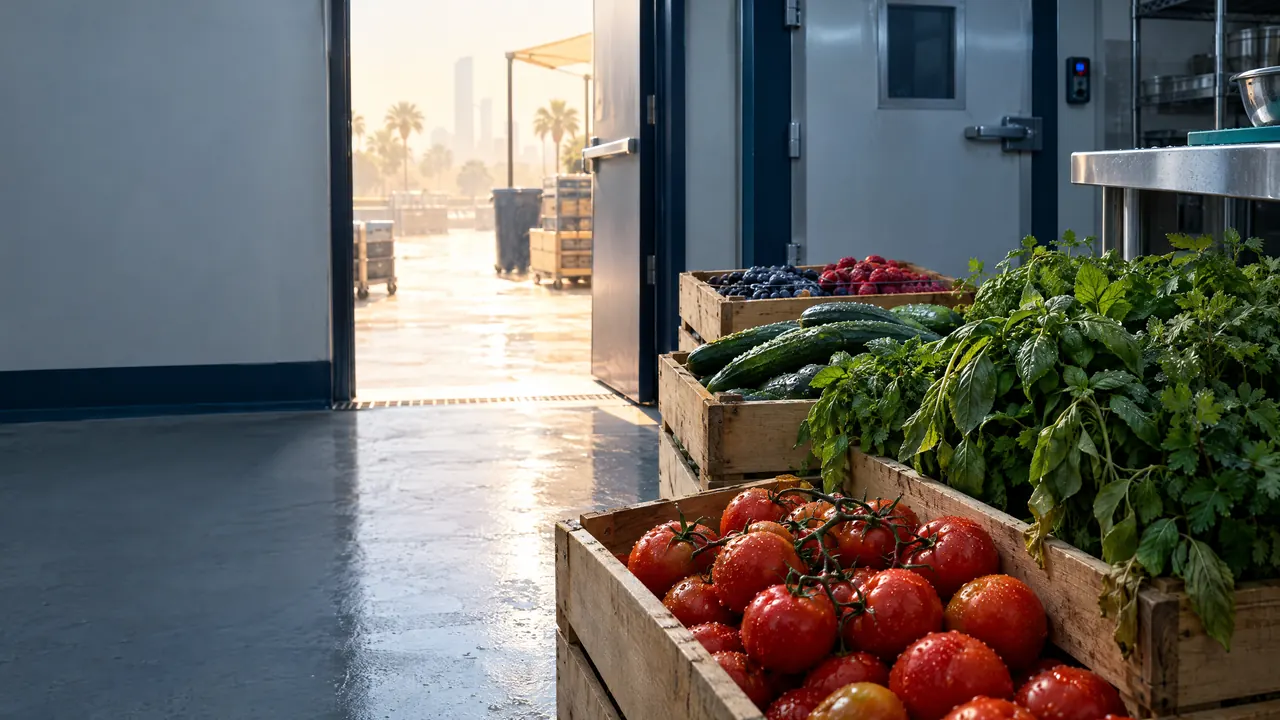
Door to cold room: under 10 minHouse rule example
Step 2 of 4: Date it, then rotate it
Label every delivery with its date and use the oldest stock first. Humidity turns a forgotten crate at the back into waste within days.
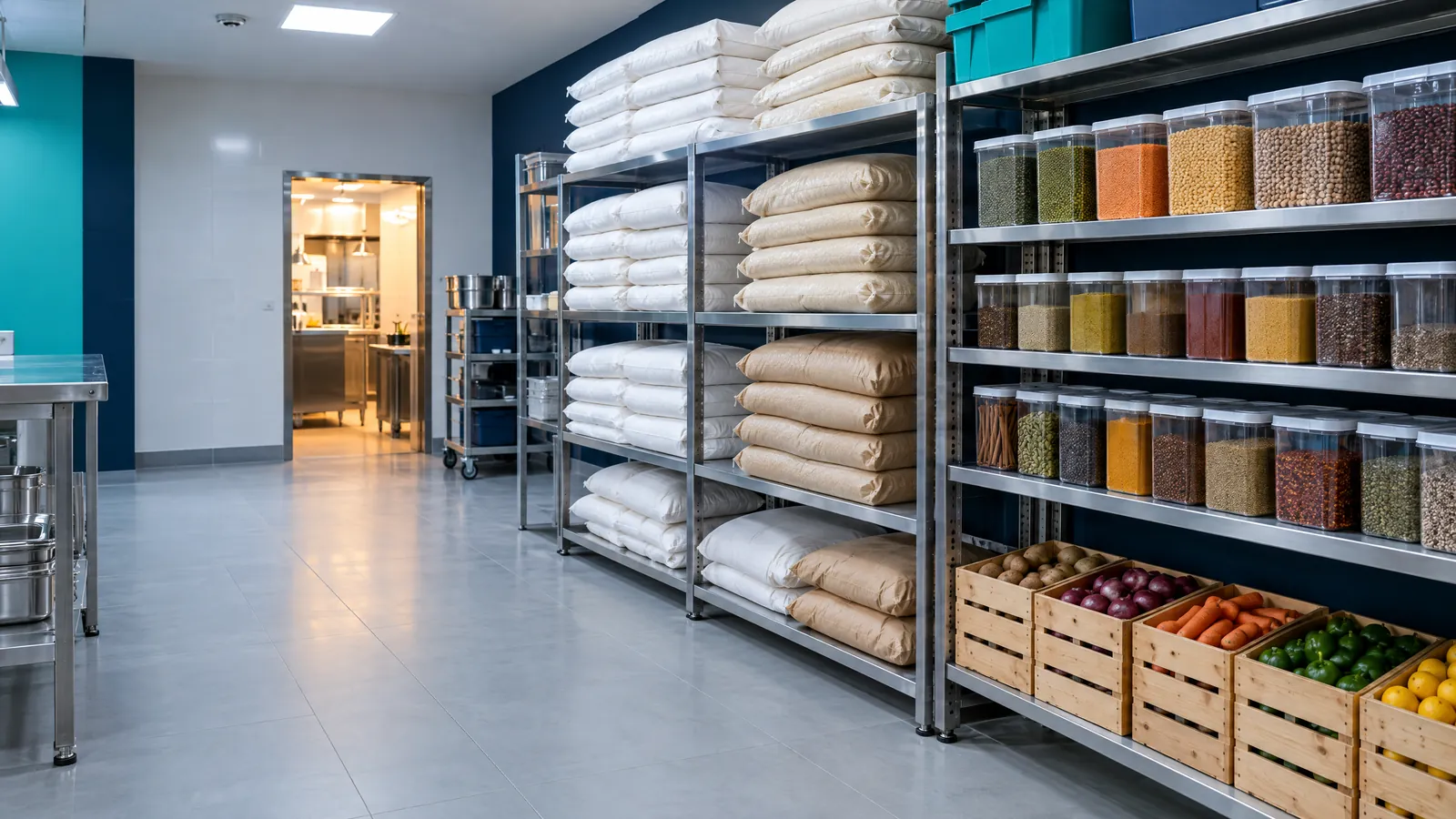
First in, first outEvery shelf
Step 3 of 4: Record every discard
Log waste when it happens, with a reason such as spoiled, expired or over-produced. TajerGo records wastage by branch from the inventory screen.
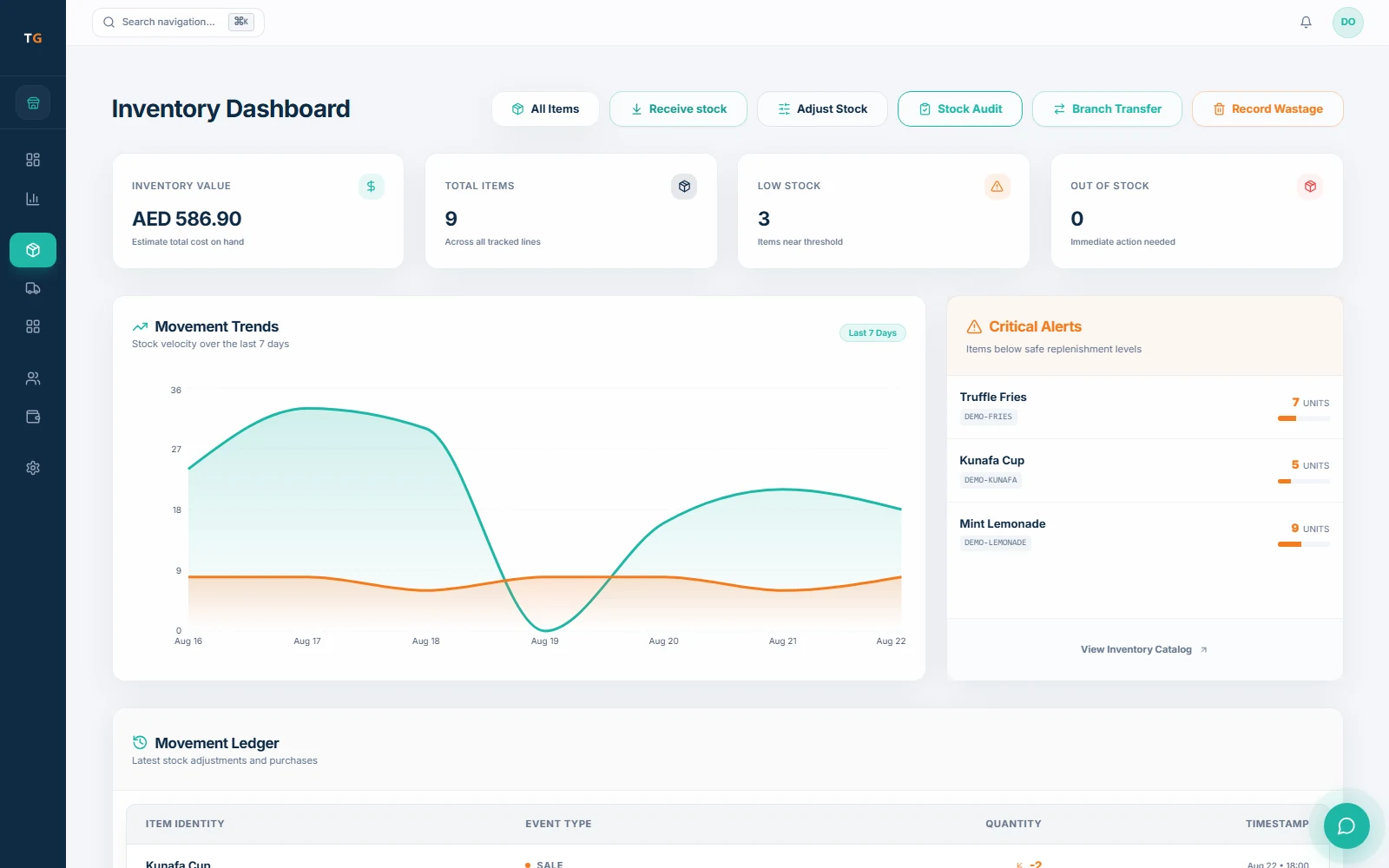
Herbs: 0.8 kg spoiledWorked example
Step 4 of 4: Order for the week you will have
Read recent sales and recorded waste together, then order perishables in smaller, more frequent deliveries while the heat lasts.
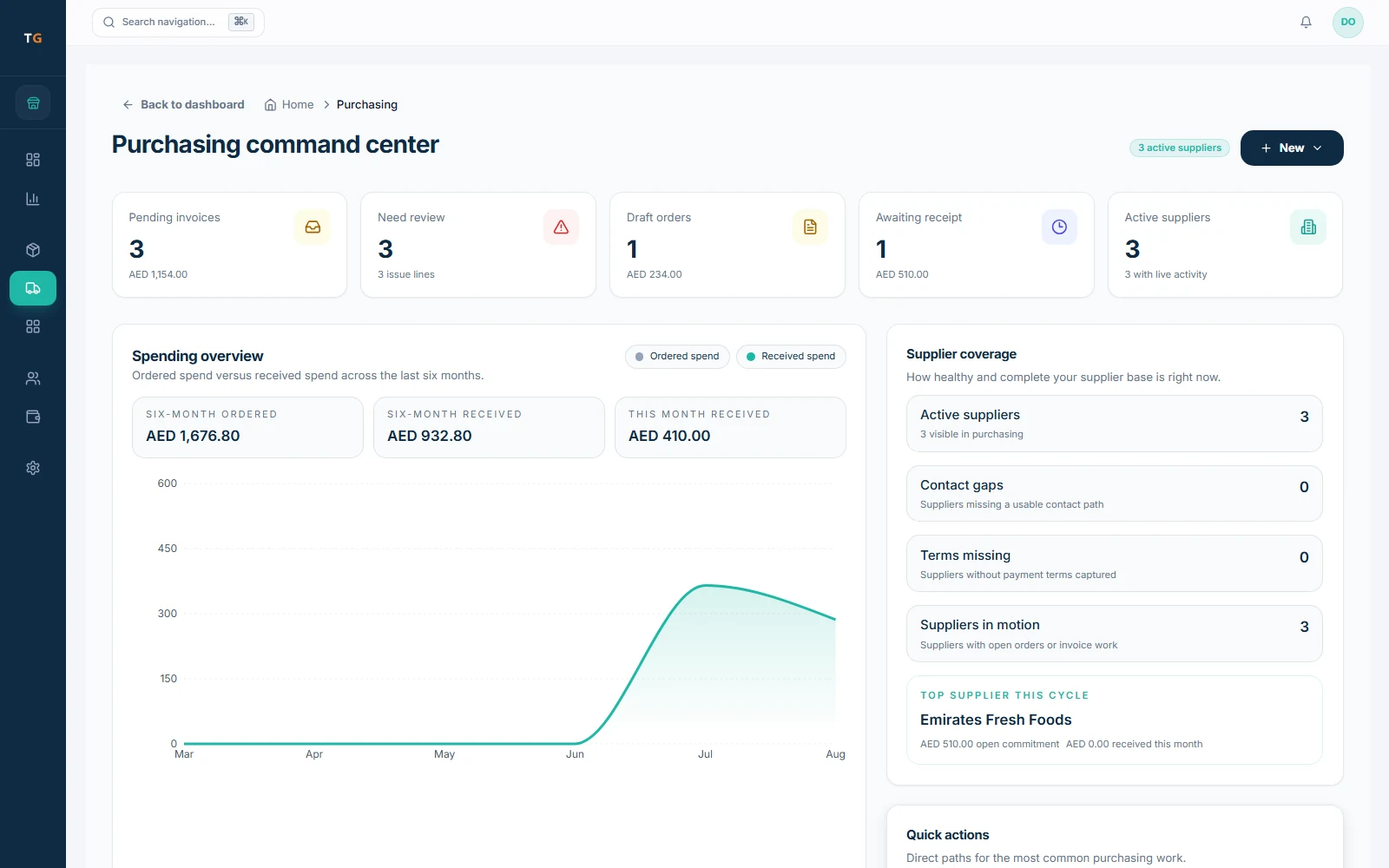
Leafy herbs: twice a weekWorked example
Product screens show demonstration data. Venue photos are illustrative.
Read the steps as text
Step 1: move deliveries from the door into cold storage quickly, because heat on the loading bay shortens shelf life. Step 2: date every delivery and use the oldest stock first. Step 3: record every discard with a reason when it happens; the TajerGo inventory screen has a Record Wastage action. Step 4: use recent sales and recorded waste together to order perishables in smaller, more frequent deliveries during the hottest months.
What is FIFO and why is it critical in UAE restaurants?
FIFO (first in, first out) means the oldest stock is used before newer stock. It fails in a predictable way: new stock goes to the front, the old stock ages at the back, and someone finds it past its date. In a cooler climate a rotation slip costs a few days of margin. In a UAE summer it costs the product.
To make FIFO stick:
- Date every item as it enters storage.
- Place new stock behind existing stock, every time.
- Make rotation part of the opening checklist.
- Use shelving that brings older items forward, such as gravity-fed racks.
- Spot-check that the front item really is the oldest.
What are the main causes of food waste in UAE restaurants?
| Cause | What happens | Typical fix |
|---|---|---|
| Poor rotation | New stock is used first; old stock expires | FIFO, date labels, training |
| Over-ordering | Buying to habit, not demand | Order from recent sales |
| Over-production | Prepping more than you sell | Prep guides tied to expected covers |
| Cold-chain breaks | Warm receiving, storage or prep | Receiving checks, temperature logs |
| Poor expiry visibility | Nobody knows what is about to expire | Date labels and regular counts |
| Delivery damage | Stock arrives damaged or part-spoiled | Check on the goods received note, reject what fails |
| Menu sprawl | Low-volume items turn over slowly | Trim the menu |
In the UAE, cold-chain breaks and poor expiry visibility carry more risk than elsewhere because the climate punishes them faster.
How does ordering to demand reduce food waste?
Most waste starts with over-ordering. If you expect to sell about 40 portions of a dish over three days, order and prep for 40 plus a small buffer, not 60 "to be safe".
Your own sales history by item, day and hour is the base. Adjust it for:
- Day of week: Friday and Saturday evenings behave very differently from Sunday lunch.
- Ramadan: the demand curve moves to iftar and suhoor. See Ramadan operations: a UAE restaurant readiness guide.
- Holidays and events: National Day, Eid and large events in Dubai or Abu Dhabi can be planned for.
- Weather: extreme heat or winter rain can cut footfall suddenly.
How do temperature controls protect perishable stock?
Three lines of defence:
- Receiving. Probe every chilled or frozen delivery before you accept it. Chilled should be 0-5°C, frozen -18°C or below. Reject what is outside the range and note what arrived, its condition and its temperature.
- Storage. Log walk-in and reach-in temperatures daily, twice a day in peak summer. A walk-in running at 8°C instead of 3°C silently shortens the life of everything in it.
- Kitchen. Take out only what you need and keep the rest cold. Even a short time on a warm surface matters in summer.
What does wastage tracking tell you about your business?
Logging each discard with a reason turns the bin into data:
- Spoilage concentrated in one category usually means you over-order it.
- The same items wasted every Tuesday point to the weekend's ordering or Tuesday's prep.
- One supplier's stock spoiling early is a supplier conversation.
- Waste concentrated on one shift or station is a training issue.
Use a small set of reasons (spoiled, expired, over-production, damaged) and keep them consistent. Ne'ma, the UAE's National Food Loss and Waste Initiative, targets reductions from food service, so check its latest figures if you need national numbers.
Read next: The state of the UAE F&B market: what operators face in 2026 (pillar) · Ramadan operations: a UAE restaurant readiness guide · Opening a restaurant in Dubai: the operations setup checklist
Frequently asked questions
How does UAE humidity affect food more than just the heat?
Humidity accelerates mould growth on exposed surfaces - baked goods, cut produce, and proteins are particularly vulnerable. It also makes evaporative cooling less effective, meaning the ambient temperature in an inadequately air-conditioned storeroom rises faster than it would in a dry climate. The combination of heat and humidity is more damaging than either alone.
What temperature should my restaurant walk-in be running at?
Chilled storage should be held between 0°C and 5°C. Frozen storage should be at -18°C or below. In UAE conditions, check and log these temperatures at least once daily - twice in peak summer - because equipment working harder in hot weather is more likely to drift out of range.
Is FIFO required by UAE food safety regulations?
UAE food safety regulations, administered through the relevant municipal food safety authorities, require that food is handled, stored, and used in ways that prevent spoilage and contamination. FIFO is a fundamental part of safe food handling practice and is expected as standard operating procedure. Check with your local municipality for the specific requirements applicable to your emirate and premise type.
How do I reduce waste during slow periods?
Slow periods often produce the most waste because production habits do not adjust quickly enough. Use demand forecasting to lower production targets for expected slow periods, reduce batch sizes on perishable items, and use expiry tracking to redirect near-expiry stock into specials or reduced-price promotions before it becomes a write-off.
About this guide. Maintained by the TajerGo Editorial Team. Last updated 26 Sep 2026. Worked examples use illustrative numbers, not customer results.