On this page
- What is food cost percentage?
- What is the food cost percentage formula?
- A worked AED example
- How do I calculate food cost per dish?
- What is a healthy food cost percentage in the UAE?
- Why does food cost percentage matter so much?
- What's the difference between food cost percentage and gross profit?
- How do I bring my food cost percentage down?
- In the product
- Frequently asked questions
Quick answer: Food cost percentage is calculated by dividing the cost of ingredients used by the revenue from sales, then multiplying by 100. For example, AED 30,000 of ingredients used against AED 100,000 of food sales is a 30% food cost. A healthy target for most UAE restaurants is 25-35%, varying by concept.
Food cost percentage tells you, in one figure, how much of every dirham of sales goes on ingredients. This guide gives you the formula, a worked AED example, realistic targets and the levers that move it.
What is food cost percentage?
Food cost percentage is the proportion of your sales revenue spent on the ingredients that produced it. It's expressed as a percentage so you can compare it across periods, items, and branches regardless of size. If your food cost percentage is 30%, then 30 fils of every dirham you take goes on ingredients, leaving 70 fils to cover labour, rent, utilities, and profit.
Ingredients are most operators' biggest controllable cost, so this is where margin is won or lost.
What is the food cost percentage formula?
The formula is simple:
Food cost % = (Cost of ingredients used ÷ Food sales) × 100
There are two common ways to apply it:
- Overall (period) food cost - using your purchases and inventory movement over a week or month.
- Per-item (plate) food cost - using the recipe cost of a single dish against its selling price.
For the period calculation, "cost of ingredients used" is worked out from your stock movement:
Ingredients used = Opening inventory + Purchases − Closing inventory
So you take what you started with, add what you bought, and subtract what's left - that's what you actually consumed.
A worked AED example
Say over one month your kitchen records:
| Item | Amount (AED) |
|---|---|
| Opening inventory | 20,000 |
| Purchases during month | 35,000 |
| Closing inventory | 25,000 |
| Ingredients used | 30,000 (20,000 + 35,000 − 25,000) |
| Food sales | 100,000 |
Food cost % = (30,000 ÷ 100,000) × 100 = 30%.
That tells you ingredients consumed 30% of sales - comfortably inside the healthy range, leaving 70% to cover everything else and profit.
Food cost % for a month, in four numbers
Skip the step-by-step viewStep 1 of 4: Count opening stock
Start from the value of stock on hand on day one, from a physical count rather than an estimate.
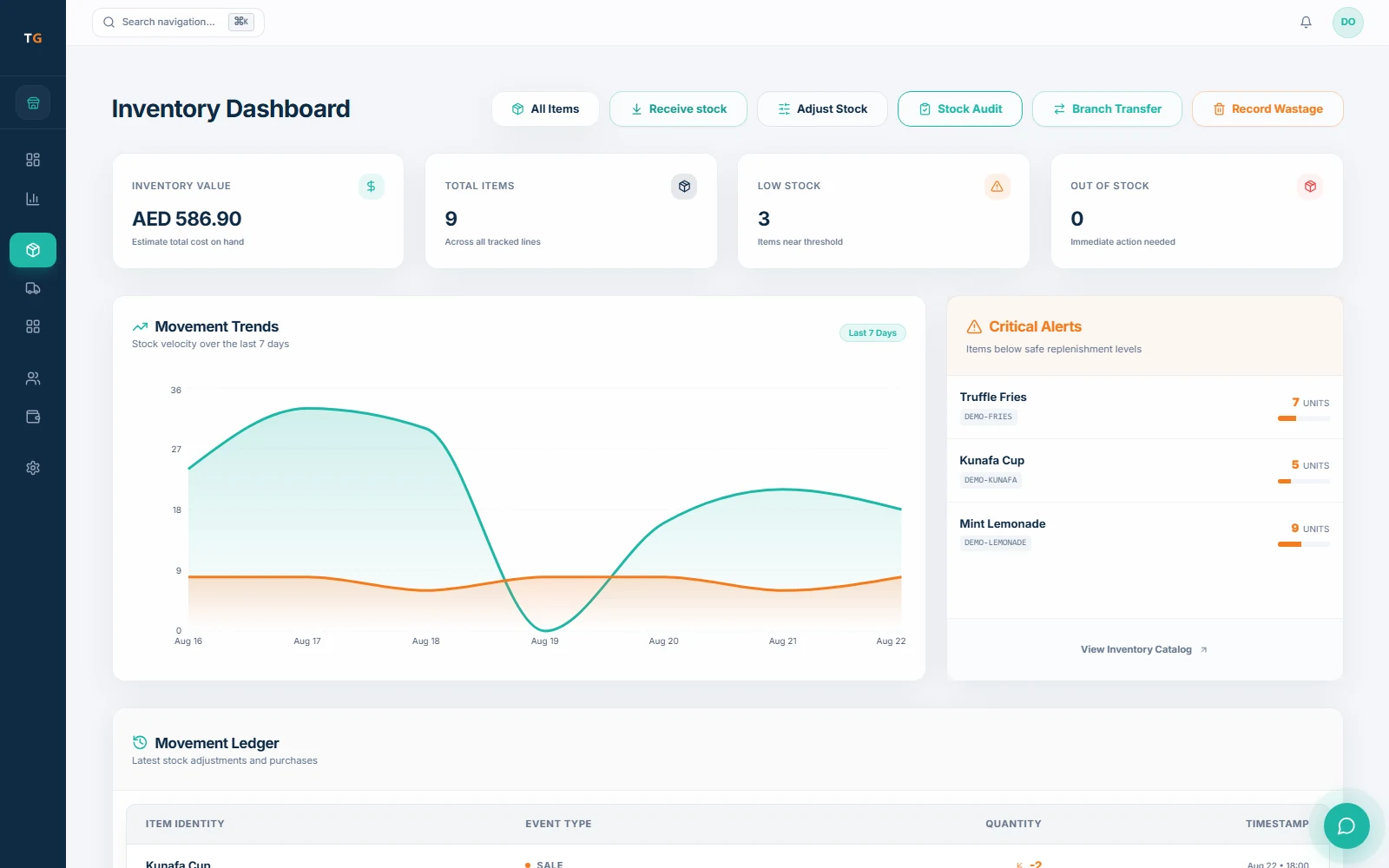
Opening stock: AED 20,000Worked example
Step 2 of 4: Add what you received
Add every purchase received during the month, at the cost on the supplier invoice.
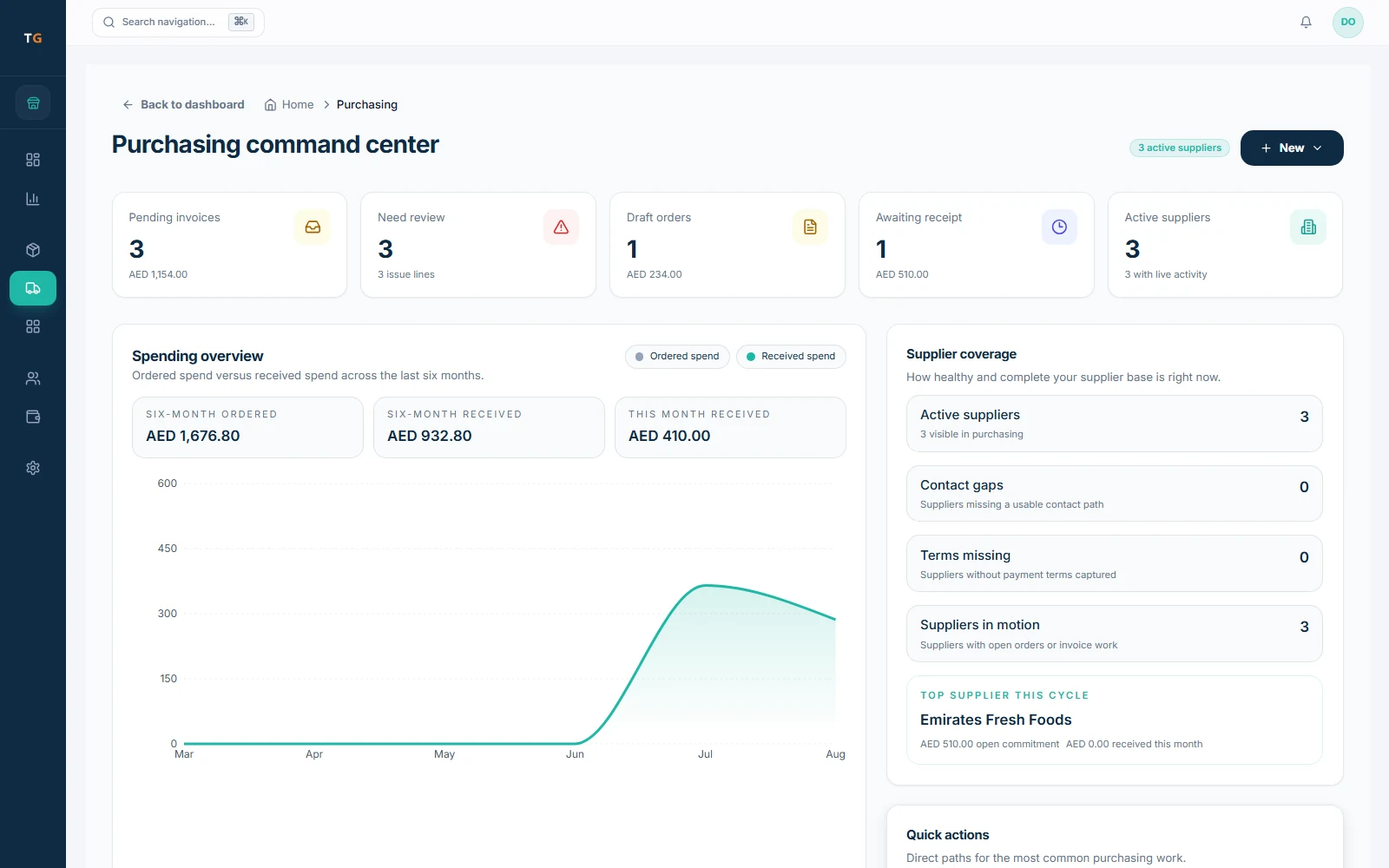
Purchases: AED 35,000Worked example
Step 3 of 4: Count closing stock
Count again on the last day. Opening plus purchases minus closing is what the kitchen actually used.
Used: 20,000 + 35,000 - 25,000 = AED 30,000Worked example
Step 4 of 4: Divide by food sales
Divide ingredients used by food sales for the same month, then multiply by 100. Compare the result with your target every month.
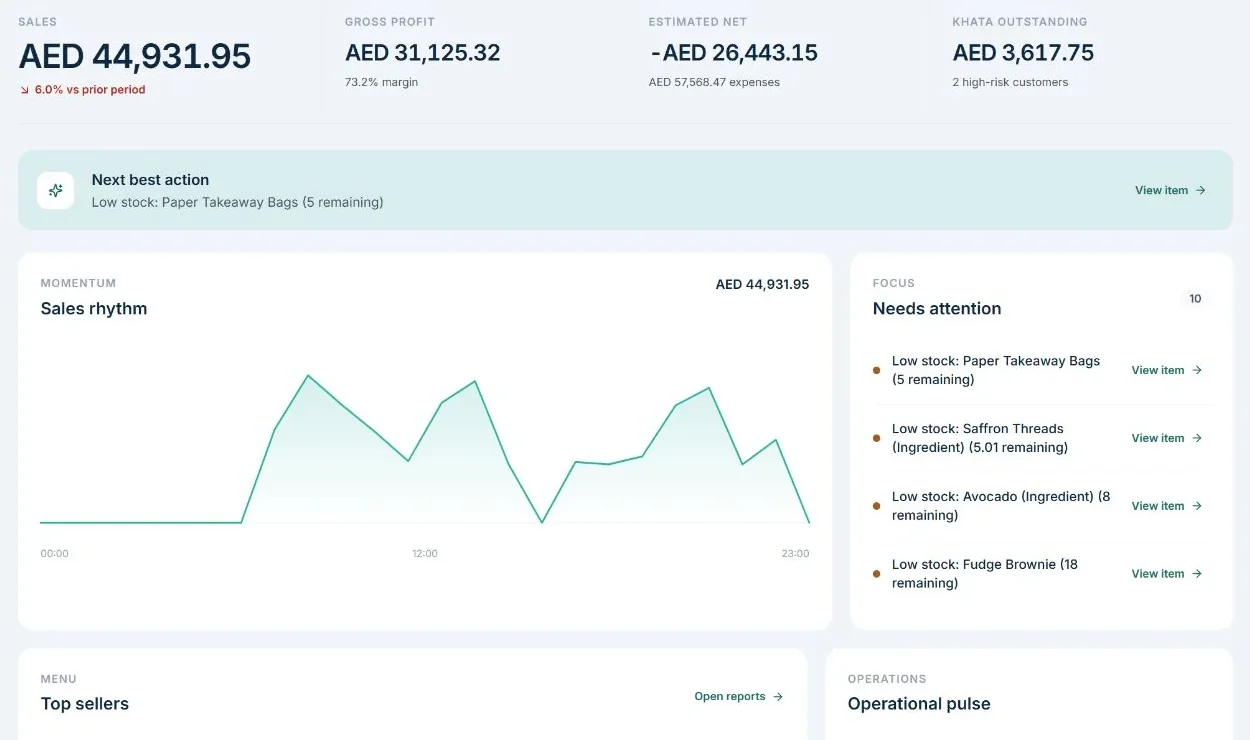
AED 30,000 / AED 100,000 = 30%Worked example
Product screens show demonstration data. Venue photos are illustrative.
Read the steps as text
Step 1: count opening stock at the start of the month, AED 20,000 in the example. Step 2: add purchases received during the month, AED 35,000. Step 3: count closing stock at the end of the month, AED 25,000; ingredients used are 20,000 plus 35,000 minus 25,000, which is AED 30,000. Step 4: divide ingredients used by food sales for the same month and multiply by 100; AED 30,000 on AED 100,000 of food sales is a 30% food cost.
How do I calculate food cost per dish?
Per-item food cost uses recipe costing instead of inventory movement:
- Add up the cost of every ingredient in the dish (the recipe cost).
- Divide by the dish's selling price (net of VAT).
- Multiply by 100.
Example: a burger that costs AED 12 in ingredients and sells for AED 40 (net) has a plate food cost of (12 ÷ 40) × 100 = 30%. Doing this for every menu item shows you exactly which dishes are efficient and which are quietly dragging your margin down.
What is a healthy food cost percentage in the UAE?
For most UAE restaurants, a healthy food cost percentage sits between 25% and 35% of the selling price. But it varies by concept:
| Concept | Typical food cost range |
|---|---|
| Café / coffee-led | Often lower (high-margin drinks) |
| Casual dining / QSR | Around the 28-33% middle |
| Fine dining / steakhouse | Higher (premium ingredients push toward 35%+) |
There's no single "correct" number - a steakhouse running 35% on expensive cuts can be perfectly healthy, while a café should be lower. What matters is knowing your target for your concept and watching the figure against it.
Why does food cost percentage matter so much?
Because it's the biggest controllable cost in the business, and small movements compound. A food cost that drifts from 30% to 34% doesn't sound dramatic - but on AED 100,000 of monthly sales that's AED 4,000 of profit gone every month, AED 48,000 a year, usually without anyone noticing why. Tracking the percentage is how you catch that drift early.
What's the difference between food cost percentage and gross profit?
They're two sides of the same coin. If your food cost is 30%, your gross profit margin on food is 70% - the share left after ingredient cost. Owners who think in margin and owners who think in food cost are looking at the same efficiency from opposite ends. Both are useful: food cost percentage for benchmarking your kitchen, gross profit for understanding what's actually left to run the business on.
How do I bring my food cost percentage down?
If your number is above target, the levers (each covered in depth elsewhere in this cluster) are:
- Portion control - over-portioning silently inflates cost on every plate.
- Cut waste - spoilage and over-prep are pure lost profit.
- Recipe costing and pricing - make sure each dish is priced for its true cost.
- Menu engineering - promote profitable dishes, fix or drop the losers.
- Track supplier prices - small invoice creep adds up across the year.
The common thread: you can only manage what you can see. The owners who control food cost are the ones who measure it continuously, not once a year.
Read next: What is a healthy food cost percentage in the UAE? · Theoretical vs actual food cost: closing the gap · Recipe costing for UAE restaurants · How to reduce food cost without lowering quality
Frequently asked questions
How do I calculate food cost percentage?
Divide the cost of ingredients used by your food sales, then multiply by 100. For a period, work out ingredients used as opening inventory plus purchases minus closing inventory. For a single dish, divide its recipe cost by its net selling price and multiply by 100.
What is a healthy food cost percentage for a UAE restaurant?
Most UAE restaurants aim for 25-35% of the selling price. Cafés are often lower thanks to high-margin drinks, while fine dining and steakhouses run higher because of premium ingredients. The right target depends on your concept.
What's the food cost formula with a worked example?
Food cost % = (ingredients used ÷ food sales) × 100. If you used AED 30,000 of ingredients against AED 100,000 of sales, that's a 30% food cost.
What's the difference between food cost percentage and gross profit margin?
They're complementary: a 30% food cost means a 70% gross profit margin on food. Food cost percentage measures kitchen efficiency; gross profit measures what's left after ingredient cost.
How often should I check my food cost percentage?
Continuously, or at least every period - not once a year. Small upward drift compounds quickly into lost profit, so frequent tracking is how you catch and correct it early.
About this guide. Maintained by the TajerGo Editorial Team. Last updated 26 Sep 2026. Worked examples use illustrative numbers, not customer results.