On this page
- What Does Recipe Costing Software Do?
- Why Manual Recipe Costing Becomes Difficult
- The Core Recipe-Costing Calculation
- A Worked Example in AED
- Purchase Cost Versus Usable Ingredient Cost
- How Sub-Recipes Improve Costing Accuracy
- Features to Look for in Food Costing Software in the UAE
- How Recipe Costing Supports Menu Pricing
- How to Set Up a Recipe-Costing System
- Common Recipe-Costing Mistakes
- How to Evaluate Recipe Costing Software Before Buying
- Price Every Dish Using Current Operating Data
- In the product
- Frequently Asked Questions
A profitable menu starts with knowing what each dish costs to produce. Recipe costing software connects ingredient quantities, purchase prices, yield, portion size and selling price, giving restaurant owners a clearer view of plate cost and gross margin.
The difficult part is not calculating one recipe. A restaurant may have hundreds of menu items, modifiers, sauces, sub-recipes and changing supplier prices. When those costs are maintained in separate spreadsheets, the numbers quickly become outdated.
A connected costing system can make the process more consistent. It records how ingredients become menu items, recalculates costs when approved ingredient prices change and helps the team review whether current menu prices still make commercial sense.
What Does Recipe Costing Software Do?
Recipe costing software calculates the ingredient cost of a menu item from the quantities, units and ingredient prices assigned to its recipe.
For example, if a chicken dish uses:
- 180 grams of chicken
- 100 grams of rice
- 40 grams of sauce
- 15 grams of garnish
- A container for takeaway orders
The system converts every quantity into a cost, adds the components and produces a plate cost. It can then compare that cost with the dish’s selling price to calculate food-cost percentage and gross margin.
The value comes from maintaining this calculation across the full menu. When the approved price of chicken changes, every recipe containing chicken can be reviewed using the new cost. The team does not need to open and manually update dozens of separate spreadsheets.
Restaurants that need a basic explanation of the calculation can first read TajerGo’s step-by-step recipe-costing guide. This article focuses on choosing, setting up and using software to manage the process continuously.
Why Manual Recipe Costing Becomes Difficult
Spreadsheets can be useful when a restaurant has a small menu and stable ingredient prices. Problems usually appear when the business becomes busier or more complex.
Ingredient prices change
Supplier prices do not remain fixed. Meat, dairy, cooking oil, fresh produce and imported ingredients can change in cost throughout the year. If recipe costs still use an old purchase price, the displayed margin may no longer be reliable.
Purchase and usage units differ
A restaurant might purchase chicken in kilograms but use it in grams. A sauce may arrive in a five-litre container but be portioned in millilitres. A case of canned drinks may contain 24 individual units.
The software must convert buying units into usable recipe units without changing the underlying cost.
Small ingredients are overlooked
Cooking oil, seasoning, garnish, sauces and packaging may look inexpensive individually. Across hundreds of daily orders, excluding them can materially understate the cost of a dish.
Yield is not always 100%
A restaurant may purchase five kilograms of an ingredient but have less usable product after trimming, peeling, cleaning or cooking. If the costing calculation assumes that every purchased gram reaches the plate, it understates the actual portion cost.
Sub-recipes appear across the menu
A tomato sauce, spice blend, stock, dough or dessert base may be prepared in batches and used in several menu items. Costing that preparation separately for every dish wastes time and increases the chance of inconsistent numbers.
A suitable system should let the restaurant create the preparation once as a sub-recipe, calculate its cost per usable unit and connect it to every relevant dish.
The Core Recipe-Costing Calculation
At its simplest, the cost of a dish is the total cost of all ingredients used for one saleable portion.
$\text{Recipe cost} = \sum (\text{ingredient quantities} \times \text{cost per usable unit})$
Food-cost percentage is then calculated as:
$\text{Food-cost percentage} = \frac{\text{Recipe cost}}{\text{net selling price}} \times 100$
If a dish costs AED 9 to prepare and has a net selling price of AED 30:
$\text{AED } 9 \div \text{AED } 30 \times 100 = 30\% \text{ food cost}$
The remaining AED 21 is not net profit. It still needs to cover labour, rent, utilities, payment fees, marketing, equipment, administrative costs and other operating expenses.
That distinction matters. Recipe cost helps measure ingredient-level profitability, but it does not replace a complete profit-and-loss review.
A Worked Example in AED
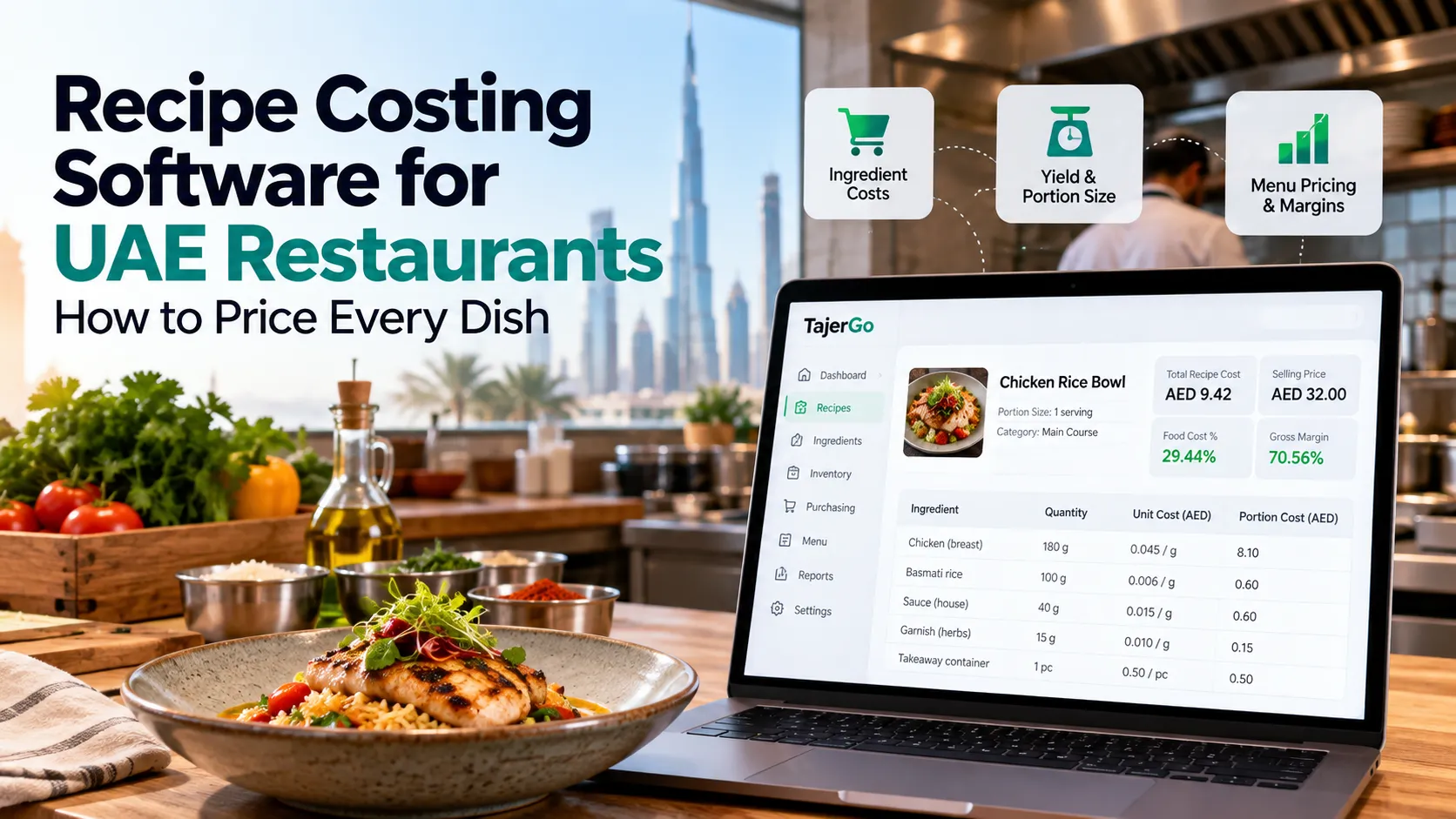
Consider a restaurant costing one portion of grilled chicken pasta.
| Component | Quantity used | Usable unit cost | Portion cost |
|---|---|---|---|
| Chicken breast | 160 g | AED 0.030 per g | AED 4.80 |
| Pasta | 120 g | AED 0.009 per g | AED 1.08 |
| Cream sauce | 100 ml | AED 0.018 per ml | AED 1.80 |
| Vegetables | 70 g | AED 0.012 per g | AED 0.84 |
| Oil and seasoning | One portion | Fixed portion cost | AED 0.55 |
| Garnish | One portion | Fixed portion cost | AED 0.35 |
| Total recipe cost | AED 9.42 |
If the net selling price is AED 32:
$\text{AED } 9.42 \div \text{AED } 32 \times 100 = 29.44\% \text{ food cost}$
The ingredient-level gross margin is:
$\text{AED } 32 - \text{AED } 9.42 = \text{AED } 22.58$
This example assumes that the ingredient costs already account for usable yield. If the chicken’s recorded cost is based only on the supplier invoice and ignores trimming loss, the real portion cost may be higher.
Restaurants can test a dish using TajerGo’s UAE Dish and Delivery Margin Calculator. The calculator accepts selling price, ingredient cost, waste or yield uplift, packaging, discounts, payment fees and selected VAT treatment. Its result is a contribution-margin estimate, not net profit or an automatic menu-price recommendation.
Purchase Cost Versus Usable Ingredient Cost
One of the most important functions of food costing software is separating purchase cost from usable cost.
Imagine that a restaurant buys 10 kilograms of vegetables for AED 80. After cleaning and trimming, only eight kilograms are usable.
The purchase cost is:
$\text{AED } 80 \div 10\text{ kg} = \text{AED } 8\text{ per purchased kilogram}$
The usable cost is:
$\text{AED } 80 \div 8\text{ kg} = \text{AED } 10\text{ per usable kilogram}$
If a recipe uses 250 grams of the prepared vegetable, its cost should be based on AED 10 per usable kilogram, not AED 8.
Ignoring yield would give a portion cost of AED 2. The yield-adjusted cost is AED 2.50. That difference becomes significant when the item is sold hundreds of times.
Yield handling is especially important for meat, seafood, fresh produce, bakery production and ingredients that lose weight during cooking.
How Sub-Recipes Improve Costing Accuracy
A sub-recipe is a prepared component used within another recipe. Common examples include:
- Curry bases
- Pizza dough
- Soup stock
- Salad dressing
- Marinades
- Dessert sauces
- Spice blends
- Bakery fillings
Suppose a kitchen prepares ten litres of tomato sauce for AED 120 and records a final usable output of 9.5 litres.
The cost per litre is:
$\text{AED } 120 \div 9.5 = \text{AED } 12.63$
If a pasta dish uses 120 ml of the sauce, the sauce cost for that dish is approximately AED 1.52.
Creating the sauce as a sub-recipe allows the same cost to flow into every dish that uses it. When tomato, oil or seasoning prices change, the restaurant updates the component and reviews the affected menu items.
This is more dependable than entering a different estimated sauce cost into every recipe.
Features to Look for in Food Costing Software in the UAE
A long feature list does not guarantee accurate costing. The following capabilities have a direct effect on the quality of the calculation.
1. Ingredient and unit mapping
The system should connect every recipe ingredient with the correct inventory item and unit. It should support conversions such as:
- Kilograms to grams
- Litres to millilitres
- Cases to individual units
- Packs to portions
- Batches to usable output
Incorrect unit mapping can create extreme cost errors. A kilogram entered as one gram, for example, can make a recipe appear far cheaper than it is.
2. Approved ingredient costs
Recipe costs should come from a controlled ingredient-cost record. Restaurants must also understand whether the system uses the latest purchase price, an approved price, a moving average or another costing method.
No method can correct an inaccurate source record. Supplier invoices, quantities, units and item matches still need review.
3. Yield percentage
The system should support a practical way to record usable yield or waste. This helps account for trimming, preparation loss and production output.
Yield assumptions also need periodic testing. A theoretical yield entered during setup may differ from what the kitchen consistently achieves.
4. Sub-recipes and batch recipes
Sub-recipe support reduces repeated work and keeps common components consistent across the menu. Bakeries and central kitchens should also check whether the software can record planned batch output, actual output, waste and cost per finished unit.
TajerGo’s recipes and batch-production workflow connects ingredient and unit mapping, approved cost context, planned production, actual material use, output, yield and cost review. Feature availability depends on the selected plan, permissions and configuration.
5. Portion and modifier costing
Customers may add cheese, choose a larger portion, replace dairy milk with an alternative or remove an ingredient. The system should show how supported modifiers affect cost, not only the selling price.
This is particularly useful for cafes, quick-service restaurants and concepts with highly customised orders.
6. Purchase and inventory connection
A recipe-costing tool becomes more useful when it connects with purchasing and inventory. Supplier prices then contribute to approved ingredient records, while sales and recipes can inform expected stock movement.
TajerGo’s restaurant inventory workflow explains how ingredient movement, recipes, receiving, counts and stock controls fit into restaurant operations.
7. Menu-level margin visibility
Owners should be able to review more than one dish at a time. A useful report can show:
- Recipe cost
- Food-cost percentage
- Gross margin in AED
- Margin percentage
- Current selling price
- Ingredient price movement
- Missing or outdated cost records
This helps identify which items require immediate review.
8. Branch-level control
A multi-branch restaurant may pay different supplier prices or achieve different yields at each location. The software should make it clear whether recipes and ingredient costs are shared centrally, managed by branch or handled through a controlled combination.
Without clear branch rules, a group-level average can hide local problems.
9. Review and approval controls
AI can help prepare recipe drafts or identify possible ingredient matches, but kitchen staff should confirm ingredients, quantities, units, yields and allergens. Important changes should follow defined permissions and approval steps.
A generated recipe is a starting point, not a verified kitchen specification.
How Recipe Costing Supports Menu Pricing
A menu price cannot be decided from ingredient cost alone. The calculation provides an important starting point, but owners must also consider the concept, customer expectations, portion size, competitor positioning, labour intensity and operating costs.
Cost-based starting price
A restaurant can estimate a starting price using its target food-cost percentage:
$\text{Starting price} = \frac{\text{Recipe cost}}{\text{Target food-cost percentage}}$
If a dish costs AED 10 and the target food cost is 30%:
$\text{AED } 10 \div 0.30 = \text{AED } 33.33$
This does not mean AED 33.33 is automatically the correct menu price. The restaurant still needs to review tax treatment, customer demand, competing products and the rest of the cost structure.
Contribution matters more than percentage alone
A lower food-cost percentage is not always better.
- Dish A sells for AED 25 and costs AED 6. Its ingredient contribution is AED 19.
- Dish B sells for AED 50 and costs AED 17. Its ingredient contribution is AED 33.
Dish B has a higher food-cost percentage, but it contributes more dirhams before other costs. Sales volume, kitchen capacity and preparation time will affect which item creates more value for the restaurant.
Delivery orders need a separate scenario
Delivery orders may include packaging, customer discounts, platform deductions and payment fees that do not apply to dine-in orders in the same way. A dish that works at one dine-in price may produce a weak delivery contribution margin.
Restaurants should assess delivery economics separately instead of treating the dine-in food-cost percentage as the complete answer.
How to Set Up a Recipe-Costing System
Good software cannot produce dependable results from incomplete records. Setup should follow a controlled sequence.
- Step 1: Clean the ingredient list
Create one standard record for every purchased ingredient. Remove duplicates such as “tomato,” “tomatoes” and “fresh tomato” when they refer to the same stock item. Keep genuinely different grades, brands or pack formats separate when they have different costs or operational uses.
- Step 2: Standardise units
Define how every item is purchased, stored and used. Confirm conversion factors before building recipes. If flour is purchased in 25 kg bags, stocked in kilograms and used in grams, the system needs a dependable conversion between all three levels.
- Step 3: Validate supplier costs
Review recent supplier invoices and confirm item matches, quantities, discounts and tax treatment. A costing system will faithfully reproduce an incorrect ingredient price if the source record is wrong.
- Step 4: Build and test sub-recipes
Create sauces, bases, doughs, stocks and other common preparations first. Record realistic output and yield before using them inside menu recipes.
- Step 5: Enter complete menu recipes
Include oils, seasoning, garnishes, sauces and supported packaging where relevant. Avoid using a general miscellaneous percentage when the ingredient can be measured reliably.
- Step 6: Confirm portion sizes with the kitchen
A recipe may specify 150 grams while staff regularly serve 180 grams. The costing record should reflect the approved operational portion, and the kitchen should have a practical way to follow it.
- Step 7: Review calculated margins
Check high-volume items first. A small error on a top-selling dish can have a larger monthly effect than a large error on an item that rarely sells.
- Step 8: Establish an update routine
Define who reviews supplier-price changes, recipe edits, yields and menu prices. Software keeps records connected, but the restaurant still needs ownership and review discipline.
Common Recipe-Costing Mistakes
- Using an old ingredient price: A recipe last updated six months ago may no longer represent current purchasing costs. Link costing to controlled purchase records and review unusual supplier-price movements.
- Ignoring preparation loss: Purchase weight and usable weight are often different. Record a realistic yield or use actual production output where available.
- Excluding small components: Oil, garnish, sauce, seasoning and takeaway packaging add cost. Excluding them across a high sales volume can distort the expected margin.
- Mixing gross and net selling prices: The numerator and denominator must follow the same basis. Restaurants should confirm how VAT is treated in their pricing and reporting setup with their own tax or finance adviser.
- Treating theoretical cost as actual cost: Recipe costing shows what a dish should cost when staff follow the approved recipe and portion. Actual food cost is influenced by waste, over-portioning, incorrect receiving, unrecorded consumption, stock adjustments and other operating differences.
- Assuming software replaces physical checks: Software cannot confirm how much stock is physically present unless staff record counts, receiving, waste and production accurately. Digital records and physical operating routines must support each other.
How to Evaluate Recipe Costing Software Before Buying
Ask the vendor to demonstrate the system using one of your real recipes and a redacted supplier invoice.
During the demonstration, check whether the software can:
- Match purchased ingredients with recipe ingredients.
- Convert buying units into recipe units.
- Account for yield and preparation loss.
- Create reusable sub-recipes.
- Update affected recipes when an approved ingredient cost changes.
- Show food-cost percentage and margin in AED.
- Separate dine-in and delivery assumptions where required.
- Support branch-level costs and permissions.
- Keep missing or uncertain data visible.
- Explain which capabilities are included in each plan.
Do not make the decision from an AI label or dashboard screenshot alone. Test the complete path from supplier cost to ingredient record, recipe, selling price and margin report.
Price Every Dish Using Current Operating Data
Restaurant margins are difficult to protect when recipe costs live in isolated spreadsheets. Connecting ingredient records, supplier costs, yields, recipes and selling prices gives owners a clearer way to review the menu as costs change.
TajerGo helps UAE restaurant teams connect recipe costing with inventory and supported production workflows.
Read next: Recipe Costing UAE Restaurant Guide · Restaurant Inventory Software UAE
Frequently Asked Questions
What is recipe costing software?
Recipe costing software calculates the ingredient cost of a dish from its recipe quantities, units, yields and ingredient prices. It can then compare the calculated plate cost with the selling price to show food-cost percentage and ingredient-level margin.
Can recipe costing software set menu prices automatically?
It can calculate a cost-based starting price or show a price required for a selected margin scenario. The final menu price still requires human judgment about VAT treatment, labour, overhead, demand, competition, positioning and customer expectations.
What is the difference between recipe cost and food cost?
Recipe cost is the expected ingredient cost of one dish based on its approved recipe. Actual food cost measures the cost of ingredients consumed across the restaurant during a period. Waste, over-portioning, stock differences and unrecorded usage can cause actual food cost to differ from recipe-based expectations.
How does yield affect recipe cost?
Yield measures how much usable product remains after trimming, cleaning, cooking or processing. A lower yield increases the cost of each usable unit because the full purchase cost is spread across a smaller usable quantity.
What is a sub-recipe?
A sub-recipe is a prepared component, such as a sauce, dough or stock, used in one or more menu items. The system calculates the component’s cost per usable unit and adds the required amount to each connected dish.
Can the software manage recipe costs for multiple branches?
Some systems support central recipes with branch-specific ingredient costs, permissions and reporting. Restaurants should confirm exactly how recipes, purchase prices and updates are controlled across locations before implementation.
How often should restaurant recipe costs be reviewed?
Review them whenever material ingredient prices, portions, recipes, yields or suppliers change. High-volume and high-cost dishes should also receive scheduled checks because small inaccuracies can create a significant monthly difference.
Is a recipe cost calculator the same as complete costing software?
No. A recipe cost calculator restaurant teams use for one dish can test a limited pricing scenario. Complete costing software manages ingredient records, units, recipes, sub-recipes, supplier-cost changes and menu-level reporting across ongoing operations.
About this guide. Maintained by the TajerGo Editorial Team. Last updated 24 Sep 2026. Worked examples use illustrative numbers, not customer results.