On this page
- What Restaurant Loyalty Software Should Help You Do
- Why Constant Discounts Can Weaken the Economics
- Build Loyalty Around Recognition, Convenience and Access
- Start With Reliable Customer Records
- Match the Programme to Different Customer Routines
- Use Visit Signals Carefully
- Cost the Reward Before Launching It
- Make Earning and Redemption Rules Clear
- Measure Repeat Business, Not Just Membership
- What to Test in a Loyalty Software Demonstration
- Launch One Benefit the Team Can Deliver Well
- In the product
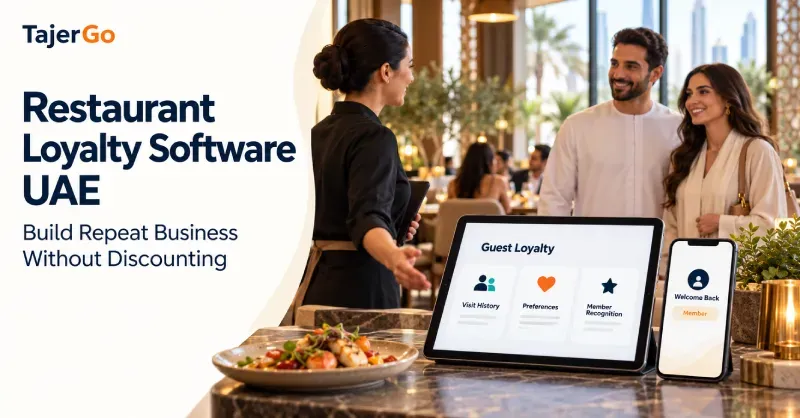
A regular customer returns because the coffee is consistent, the team remembers their order and the experience fits their routine. A discount might encourage another visit, but it cannot replace those reasons. For owners comparing restaurant loyalty software UAE, the useful question is how the system helps the restaurant recognise and serve returning guests.
Loyalty software can connect customer visits, purchases, preferences and rewards. Used carefully, those records help staff offer relevant benefits and identify relationships that need attention.
The objective is repeat business that remains worthwhile after the cost of rewards. That requires a programme built around customer value, dependable service and clear measurement.
What Restaurant Loyalty Software Should Help You Do
A restaurant loyalty programme gives customers a reason to keep choosing the business. The software maintains the records and applies supported rules behind that programme.
Depending on the product and configuration, it may help teams:
- Connect purchases with a customer profile.
- Review visit frequency and spending.
- Maintain points, tiers and reward balances.
- Apply configured redemption rules.
- Recognise recorded product preferences.
- Identify customers whose visit patterns have changed.
- Review programme activity and results.
These capabilities serve different purposes. A points balance tracks an entitlement. A customer history helps staff understand the relationship. Neither guarantees that the guest will return.
Before choosing software, decide which customer behaviour you want to encourage and how the restaurant will deliver the promised benefit.
Why Constant Discounts Can Weaken the Economics
An offer can generate sales while reducing the contribution available to cover operating costs.
Consider a hypothetical meal with a selling price of AED 50 before VAT and an ingredient cost of AED 15.
Before a discount:
Ingredient contribution = AED 50 − AED 15 = AED 35
After a 20% price reduction:
Discounted revenue = AED 40
Ingredient contribution = AED 40 − AED 15 = AED 25
Revenue falls by 20%, but ingredient contribution per meal falls by about 28.6%.
Other expenses, including labour, rent and payment charges, still need to be covered. The promotion may be worthwhile if it creates enough additional profitable business, but more orders alone do not establish that.
Existing customers may receive savings without changing their behaviour
If a regular would have visited and paid the usual price anyway, the discount reduces revenue without necessarily creating another visit.
That is why programme results should distinguish reward use from additional business.
Customers can become accustomed to promotional pricing
Repeated offers may encourage some guests to wait for the next deal. A restaurant then needs to understand whether it is building a habit around the experience or around the lower price.
This does not mean every discount is unsuitable. It means the restaurant should use a defined objective and review the result.
Build Loyalty Around Recognition, Convenience and Access
A programme can offer value without reducing every bill.
The best benefits fit the restaurant’s service model and can be delivered reliably. The following are programme ideas to evaluate, not a claim that every loyalty platform supports them.
| Benefit idea | Value for the customer | Operating consideration |
|---|---|---|
| Remembered order preferences | Less repetition at the till | Accurate records and staff access |
| Early booking access | A chance to reserve before general release | Clear availability rules |
| Invitation to a tasting | A relevant experience | Capacity, staffing and product cost |
| Access to a limited menu item | Something distinctive to try | Stock and fulfilment limits |
| A selected add-on after a milestone | A tangible thank-you | Cost and redemption controls |
| Easier repeat ordering | A quicker familiar purchase | Correct customer and order matching |
A small restaurant should start with a benefit the team can explain in one sentence. Complicated rules can add checkout time and create disagreements.
Recognition should feel useful
Remembering that a guest usually orders an oat-milk coffee can make the visit easier. Mentioning every detail of their purchase history can feel intrusive.
Let customers confirm their preferences. Do not treat a previous choice as a permanent instruction.
Convenience must remain practical
Priority benefits should not create promises the restaurant cannot honour. If early access applies only to selected events or booking windows, say so clearly.
A disappointing reward experience can undermine the relationship the programme was meant to strengthen.
Start With Reliable Customer Records
Restaurant CRM software becomes useful when purchases are connected to the correct person.
Duplicate profiles, shared phone numbers and orders assigned to the wrong customer can distort visit history and balances.
Link the customer at the right point
Give staff a consistent process for finding or creating a profile and attaching it to an order.
Keep enrolment brief. Collect information that serves a defined purpose rather than asking for unnecessary details during a busy checkout.
Make the benefit clear
Customers should understand why they are joining, what they can earn and how they can use it.
A sign-up count is not a useful achievement if guests do not understand the programme or staff cannot explain it.
Separate membership from promotional communication
Joining a loyalty programme and agreeing to receive marketing messages should be handled as distinct choices where applicable.
Maintain clear communication preferences and an effective way to stop promotional contact. Confirm the applicable requirements for the channels and customer data your business uses.
Match the Programme to Different Customer Routines
A commuter buying coffee each morning behaves differently from a family visiting once a month.
The programme should recognise those differences rather than labelling every customer inactive after the same number of days.
First-time visitors
The immediate aim is a good first experience and a reason to choose the restaurant again.
Explain the programme after serving the guest well. Do not make registration the most memorable part of the visit.
Frequent regulars
Consistency and recognition may matter more than repeated offers.
Review whether staff can find their usual order, whether the reward is easy to use and whether the programme adds friction to a familiar routine.
Occasional high-value guests
A customer who books a larger family meal every few weeks may have a valuable relationship with the restaurant despite a lower visit count.
Assess frequency alongside spending and the nature of the visit.
Customers whose pattern has changed
A decline in visits can prompt a review. It does not explain why the customer stopped coming.
They may have changed jobs, travelled, moved or experienced a service problem. Choose a proportionate response instead of automatically issuing a discount.
Use Visit Signals Carefully
Customer records can help answer questions such as:
- How long has it been since the last recorded visit?
- Has the customer’s usual frequency changed?
- Which products do they commonly order?
- Has their average basket changed?
- Are their recent visits linked to a particular branch?
Those observations can support a decision, but the data has limits.
A customer may still visit anonymously. They may order through a channel that does not connect with their profile. A missing transaction can make a regular appear inactive.
TajerGo’s customer management and loyalty features connect recorded visits, spending, preferences and loyalty information. Its Customer DNA signals support staff review; they do not establish why a guest’s behaviour changed or guarantee a return visit.
Cost the Reward Before Launching It
A free item or upgrade still has a cost, even when the main bill stays at its usual price.
Review the ingredients, packaging, preparation time and operational impact of each benefit. Also consider whether it replaces something the customer would otherwise buy.
An illustrative reward calculation
Suppose 100 customers each complete five qualifying visits. The restaurant then provides one selected reward per customer.
If the incremental product cost is AED 4:
100 rewards × AED 4 = AED 400
Across the 500 qualifying visits:
AED 400 ÷ 500 = AED 0.80 per qualifying visit
That is a simple product-cost allocation, not the complete cost or return of the programme. It excludes software, administration, additional labour and possible displaced purchases.
Test whether the benefit creates a useful change
If the same customers would have completed those visits without the reward, the programme may mainly be adding cost.
It could still support recognition or satisfaction, but the restaurant should state that objective rather than claiming additional revenue without evidence.
TajerGo’s recipe-costing workflow can provide ingredient-cost context when evaluating a proposed food or beverage reward.
Make Earning and Redemption Rules Clear
Even a simple restaurant rewards programme needs decisions about exceptions.
Define:
- Which purchases qualify.
- Whether earning depends on visits, spending or selected products.
- Whether a minimum purchase applies.
- How refunds affect points or benefits.
- Which rewards can be combined.
- Where redemption is available.
- Who can approve a correction.
- Any validity conditions.
Define a qualifying visit
If rewards are based on visits, decide how multiple transactions close together are treated.
Otherwise, splitting one purchase into several bills could produce unintended benefits. Confirm whether the software can apply your intended rule before publishing it.
Test refunds and corrections
A refunded purchase should have a clear effect on associated points or entitlements.
Ask the provider to demonstrate a refund after points have been earned and a correction after a reward has been redeemed. These cases reveal whether the programme can be managed consistently.
Train staff on exclusions
Customers should receive the same explanation at every shift and participating outlet.
If a benefit does not apply to certain products or branches, staff need to know before the customer attempts to use it.
Measure Repeat Business, Not Just Membership
A growing member database does not prove that loyalty is improving.
Choose a few measures tied to the programme’s objective.
| Measure | What it helps assess |
|---|---|
| Second-visit rate | Whether identified first-time guests return within a defined period |
| Visit frequency | How often a defined customer group visits |
| Time between visits | Whether the interval changes |
| Reward redemption | Whether guests use the benefit |
| Reward cost | The resources used to fulfil benefits |
| Contribution after rewards | Whether the activity remains commercially worthwhile |
| Recorded complaints or opt-outs | Whether the programme creates friction |
Keep the definitions consistent. A second-visit rate needs a clear customer group and enough time for every customer in that group to return.
Example: second-visit rate
Suppose 200 identified first-time customers visited during a defined enrolment period. After allowing each person a full 30-day follow-up window, 60 had returned.
Second-visit rate within 30 days = 60 ÷ 200 × 100 = 30%
The result describes that group. It does not prove the programme caused the return visits.
Avoid misleading member comparisons
Members may spend more because frequent customers are more likely to join in the first place.
Compare similar customer groups and consider a controlled pilot where practical. Review contribution and reward costs alongside revenue.
TajerGo’s restaurant reporting tools provide sales and margin context. Confirm which loyalty measures are available directly and which require a separate calculation or export.
What to Test in a Loyalty Software Demonstration
Use a complete customer journey instead of reviewing a feature list alone.
Create a test profile, attach purchases, earn a benefit and redeem it. Then test a refund and a staff correction.
Check whether:
- Customer profiles can be found without creating duplicates.
- Staff see only the information their roles require.
- Earning rules behave as intended.
- Reward balances are understandable.
- Redemptions are recorded against the correct transaction.
- Refunds and corrections have the expected effect.
- Branch restrictions are clear.
- Communication preferences remain separate and visible.
- Reports can support the measures you intend to track.
Ask which capabilities depend on the plan, configuration or an additional service.
Launch One Benefit the Team Can Deliver Well
Choose a clear objective, such as encouraging a second visit or recognising established regulars. Select one relevant benefit, calculate its cost and write rules that staff can explain easily.
Run a small pilot long enough to observe the behaviour you want to change. Review customer response, service effort and contribution before expanding it.
Bring that programme to a TajerGo demonstration. Ask the team to show enrolment, earning, redemption and correction using your intended rules. The right setup should help the restaurant make returning worthwhile while preserving the experience and economics that keep it operating.
Read next: Restaurant Reporting and Analytics Software UAE · Restaurant POS Software UAE
About this guide. Maintained by the TajerGo Editorial Team. Last updated 27 Oct 2026. Worked examples use illustrative numbers, not customer results.