On this page
- First, Establish What Your Current PosBytz Setup Already Includes
- What Might Make an Owner Consider Switching?
- PosBytz and TajerGo: Where to Focus the Comparison
- Compare the Full Cost of Running Your Restaurant
- Test Purchasing With One Real Supplier Transaction
- Compare Recipe Costing Beyond the Dish Total
- Check Customer Credit if You Serve Offices or Regulars
- Delivery Integrations Can Decide the Shortlist
- Test Offline Behaviour on Your Intended Devices
- Make Reporting Answer a Real Owner Question
- Plan Migration Before Cancelling the Existing System
- When Staying With PosBytz May Be the Better Choice
- When TajerGo Deserves a Demonstration
- In the product
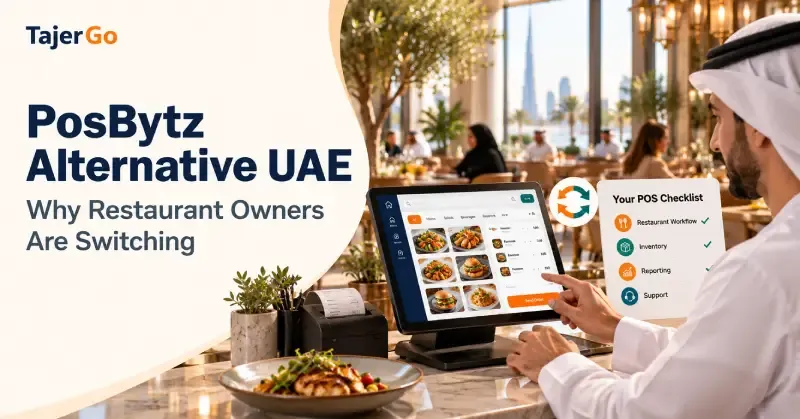
A restaurant usually starts reviewing its POS when a specific problem becomes difficult to ignore. Perhaps managers still reconcile supplier purchases outside the system, reporting takes too long, or the renewal proposal includes features the business rarely uses. If you are researching a PosBytz alternative UAE, start by identifying what your next system must improve.
There is no verified switching trend presented in this article. Instead, it examines the operational reasons an owner might consider a change and how TajerGo fits that evaluation.
This comparison is published by TajerGo. PosBytz offers a broad restaurant platform, so the decision should come from a demonstration and a like-for-like proposal, rather than an assumption that one product lacks the other’s features.
First, Establish What Your Current PosBytz Setup Already Includes
PosBytz publicly describes a restaurant platform covering POS, online ordering, inventory, food costing, CRM and accounting. Its restaurant pages also advertise kitchen displays, recipe and production management, and delivery-channel connections.
That means basic features such as billing, inventory and recipe costing are not sufficient reasons, by themselves, to switch.
Before comparing alternatives, list:
- The PosBytz modules you currently use.
- Features available in your package but not configured.
- Work completed in spreadsheets or other applications.
- Integrations the restaurant depends on.
- Problems already raised with support.
- Renewal terms and additional charges.
A missing configuration, an incomplete recipe library or a training gap may be easier to resolve within the existing setup.
Changing systems becomes more relevant when a demonstrated alternative addresses a material requirement that your current arrangement does not meet satisfactorily.
What Might Make an Owner Consider Switching?
The following are evaluation triggers, not claims about PosBytz customers or service quality.
The system no longer matches the operation
A restaurant may have started with one counter and later added table service, central production or corporate meal accounts.
The original configuration may need to change. Compare an updated proposal from the current provider with a complete alternative, rather than comparing an older setup with a new demonstration.
Staff still enter the same information repeatedly
Repeated entry across the till, purchasing spreadsheet and customer ledger creates work and opportunities for inconsistency.
Identify the exact handoff causing the problem. Ask both providers to show how that transaction moves between records.
Owners cannot explain the numbers easily
A dashboard may show sales while leaving managers uncertain about ingredient costs, outstanding customer balances or cash differences.
The requirement is not simply more charts. It is a report with clear definitions, complete source records and a practical route to investigate exceptions.
The commercial arrangement needs reassessment
Subscription cost, implementation, support and integrations should be reviewed together.
A lower headline price is useful only if the proposed package supports the work the restaurant needs.
PosBytz and TajerGo: Where to Focus the Comparison
| Area | What the published information establishes | What to verify |
|---|---|---|
| Product scope | PosBytz presents a broad restaurant platform; TajerGo connects restaurant sales and operating records | Which required functions are included in each proposal |
| Pricing | PosBytz uses tailored estimates; TajerGo publishes UAE branch-based plans | Complete cost for your outlets, users, devices and modules |
| Kitchen operations | Both publish restaurant kitchen capabilities | Routing, modifiers, station workflow and hardware |
| Inventory and costing | Both describe ingredient and recipe functions | Units, yields, production and missing-cost handling |
| Delivery channels | PosBytz advertises aggregator connections; TajerGo lists Talabat menu sync in beta | Exact live capability for each required channel |
| Offline operation | Both publish offline capability | Supported devices, payments, kitchen behaviour and recovery |
| Migration | Your records and configuration determine the scope | What transfers, what needs rebuilding and what remains archived |
Treat the table as a shortlist of questions. It does not establish identical functionality or a winner in every category.
Compare the Full Cost of Running Your Restaurant
PosBytz’s pricing page describes tailored pricing based on modules, outlets, terminals, order volume, hardware and setup.
TajerGo’s current UAE pricing lists Free, Starter at AED 99, Growth at AED 299 and Scale at AED 899 per active branch per month, before VAT. Enterprise pricing is custom.
The Free plan has published limits, including products, customers and monthly orders. Higher plans add capabilities and allowances.
Review the current TajerGo pricing and plan comparison against the actual operating requirements.
Build one comparable scope
Ask each provider to quote for the same:
- Number of outlets and registers.
- Staff access.
- Kitchen screens and printers.
- Inventory and production requirements.
- Reporting and export needs.
- Required integrations.
- Setup, migration and training.
- Support arrangements.
Do not compare a basic subscription with a proposal that includes hardware and implementation.
Calculate switching costs separately
The first-year cost can include data preparation, replacement equipment, training time and overlapping subscriptions.
Use this structure:
First-year cost = Subscription + Setup + Hardware + Migration + Training + Required add-ons
Only enter amounts confirmed in the relevant proposal. Neither a custom quote nor a public starting price establishes which system will cost less for your restaurant.
Test Purchasing With One Real Supplier Transaction
Purchasing is worth examining when the restaurant needs a clear relationship between the order, accepted delivery and supplier invoice.
Use a redacted example with a discrepancy.
Suppose the restaurant ordered 20 kg of an ingredient, accepted 18 kg and received an invoice for 20 kg at a changed price.
Ask each provider to show:
- The original order.
- The accepted quantity.
- The outstanding or rejected quantity.
- The invoice difference.
- The approval or correction process.
- The resulting stock and cost records.
TajerGo’s purchasing and supplier workflow is a relevant part of its evaluation.
Do not infer that PosBytz cannot perform a purchasing task because it is absent from a short product description. Request the same demonstration from both teams.
Compare Recipe Costing Beyond the Dish Total
Both platforms publish recipe-related capabilities. The practical question is whether the proposed setup can represent your menu accurately.
Bring a recipe containing:
- An ingredient purchased in a different unit from its recipe use.
- A prepared sauce or other component.
- A relevant yield assumption.
- A modifier that changes consumption.
- A recently changed ingredient price.
Ask how the system calculates the cost and handles incomplete information.
Check the meaning of “profit”
Selling price less ingredients is not the same as net profit.
Confirm whether a report includes packaging, labour, delivery deductions or other expenses. Two screens can show different margins because they use different definitions.
A successful demonstration should make those definitions visible.
Test a production batch if you prepare ahead
For dough, sauces or finished bakery products, check planned materials, actual use and usable output.
Then follow the finished product through storage and sale. Confirm that the same raw ingredients are not deducted twice.
Check Customer Credit if You Serve Offices or Regulars
Customer credit deserves a separate test if the restaurant allows approved customers to pay later.
Use a sample account with an opening balance, a new credit sale and a partial repayment.
The system should make it possible to explain the remaining amount and identify the transactions behind it.
TajerGo’s restaurant Khata features cover credit tabs, limits, authorised exceptions, statements and aging.
Ask PosBytz to demonstrate the equivalent requirement in its proposed configuration. The comparison should establish how each workflow operates, including permissions and corrections.
Keep collections separate from new sales
A later repayment reduces customer debt. It should not create the original sale again.
Include that check in the demonstration and migration plan, especially if opening customer balances will move to the new system.
Delivery Integrations Can Decide the Shortlist
For a delivery-led restaurant, an integration gap can outweigh other improvements.
PosBytz advertises connections with delivery platforms on its restaurant pages. Confirm the exact channels, country coverage, supported functions and charges in the UAE proposal.
TajerGo’s current restaurant page identifies Talabat menu sync as beta. Do not assume that means every delivery function or platform is supported.
For each essential channel, verify:
- Menu and modifier synchronisation.
- Order receipt.
- Availability updates.
- Status handling.
- Error recovery.
- Settlement reconciliation.
Ask to see the specific connection working. A platform logo does not establish the complete operating scope.
Test Offline Behaviour on Your Intended Devices
Both providers publish offline capability. That does not prove that every function continues during every type of connection failure.
Disconnect the internet during a controlled test and check:
- Creating a supported order.
- Recording the intended payment.
- Printing.
- Kitchen communication.
- Pending transaction visibility.
- Uploading after reconnection.
Card authorisation depends on the payment arrangement and should be checked separately.
Also distinguish a broadband outage from a local-network failure. A working till cannot guarantee that a disconnected printer or kitchen screen receives an order.
Make Reporting Answer a Real Owner Question
Choose a question the manager currently struggles to answer.
For example:
“Which high-volume menu items had the lowest ingredient contribution last week?”
Check the period, branch, sales basis, recipe costs and missing data.
Then ask for a customer-credit report or a shift-cash reconciliation. Useful reporting should let the owner trace the result back to its source.
TajerGo’s restaurant reporting features provide the relevant product scope to assess. Confirm plan access and the completeness of required records.
Avoid judging either platform from a dashboard screenshot alone.
Plan Migration Before Cancelling the Existing System
Even a suitable replacement can cause disruption if the migration is rushed.
Establish what can be exported
Review products, modifiers, recipes, customer records, stock balances, supplier details and outstanding credit.
Confirm export formats and access while the current account remains active.
Separate opening balances from historical activity
Opening stock and customer debt need a clear cutoff.
Importing old credit sales as new transactions could duplicate revenue and balances. Likewise, historical purchases should not accidentally become new receipts.
Confirm what needs rebuilding
Kitchen routing, permissions, receipt layouts and integrations may require new configuration.
Do not assume that transferring a product list recreates the restaurant’s operating setup.
Run a pilot
Test a limited menu or one location before a wider launch.
Include refunds, split payments, credit repayments, receiving discrepancies and offline recovery. These exceptions often reveal more than a normal sale.
Keep a cutover and fallback plan
Assign responsibility for the final count, open bills, payment reconciliation and go-live decision.
Retain access to historical records according to the business’s requirements.
When Staying With PosBytz May Be the Better Choice
Keeping the current system may make sense when it supports the required workflows, essential integrations work reliably and the proposed change offers little measurable benefit.
It may also be sensible to resolve configuration or training issues before taking on migration costs.
Ask PosBytz for a documented response to the current requirements. Compare that with what TajerGo demonstrates and commits to in its proposal.
A switching decision should have a clear business case, not simply a newer interface.
When TajerGo Deserves a Demonstration
TajerGo is worth evaluating when its connected approach to purchasing review, recipe costs, customer credit and owner reporting fits the restaurant’s priorities.
Start with two or three transactions that matter most to your operation. Use the same examples with both providers and record what each demonstration establishes.
Before committing, confirm scope, pricing, devices, integrations, support and migration responsibilities in writing.
Bring your current workflow and a redacted supplier invoice to a TajerGo demonstration. The useful outcome is evidence that the proposed setup can improve a specific part of running your restaurant.
Read next: Restaurant Reporting and Analytics Software UAE · Restaurant Procurement Software UAE
About this guide. Maintained by the TajerGo Editorial Team. Last updated 31 Oct 2026. Worked examples use illustrative numbers, not customer results.