

On this page
Quick answer: Recovering overdue Khata works best with consistent, friendly reminders rather than confrontation. Start gently and early, keep the tone warm, give the customer an easy way to pay, and stay regular. Automating reminders through email keeps the relationship intact while protecting the money owed - and leaves a record of every nudge sent.
The hard part of credit is not extending it. It is collecting without making a loyal regular feel chased. Most owners under-collect because the conversation is awkward, so the debt drifts until it goes cold. The fix is a calm, consistent routine.
Why is overdue Khata so hard to collect?
Three reasons, all human:
- The relationship. These are regulars and neighbours. Pushing too hard risks the loyalty that made them credit customers in the first place.
- The awkwardness. Asking face-to-face feels confrontational, so it gets put off.
- The drift. The longer a balance sits, the harder it is to recover - old debts feel less urgent to the customer and more embarrassing to raise.
The answer isn't to be tougher; it's to be consistent and early, with a tone that stays friendly.
What's the right way to ask for payment?
A few principles keep recovery effective and warm:
- Start early. A gentle reminder a day or two after a balance is due is far easier than one after a month. Early nudges feel like admin, not accusation.
- Keep the tone warm. "Hi, just a friendly reminder your balance is AED X whenever you're next in" preserves the relationship.
- Make paying easy. Tell them the exact amount and an easy way to settle. Friction loses payments.
- Be consistent, not aggressive. Regular, predictable reminders work better than occasional confrontations.
- Keep a record. A log of every reminder sent removes any "I was never told" dispute and keeps it factual.
A calm routine for overdue khata
Skip the step-by-step viewStep 1 of 4: See who is overdue
Start from the khata aging report: every balance grouped by how long it has been outstanding, oldest first.
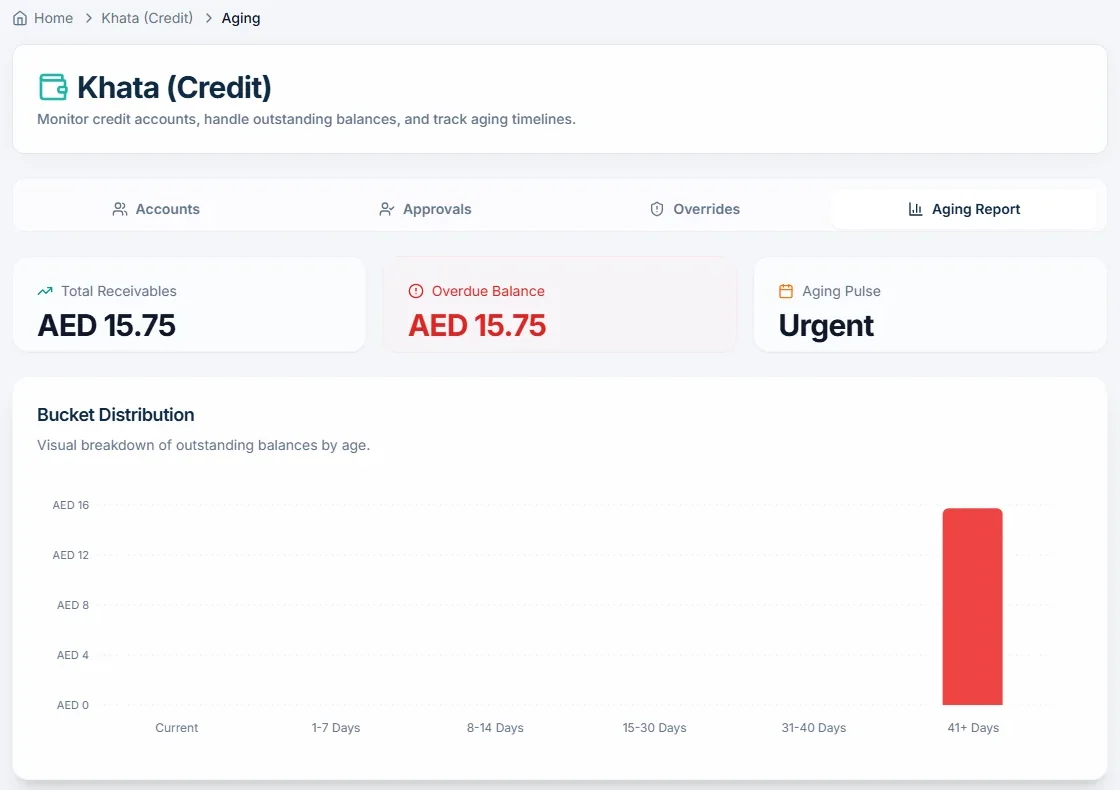
41+ days: follow up todayDemonstration data
Step 2 of 4: Start early and warm
Send the first reminder a day or two after the due date. Give the exact amount and an easy way to pay, and keep the tone friendly.

Balance due: AED 240Worked example
Step 3 of 4: Keep a steady rhythm
Follow up on a fixed schedule, not when you remember. A note of each reminder ends any "nobody told me" conversation.

Day 3, day 10, day 21Worked example
Step 4 of 4: Pause credit, keep the customer
If a balance keeps growing, lower the limit or pause new credit until it is settled. Watch total khata outstanding on the owner dashboard.
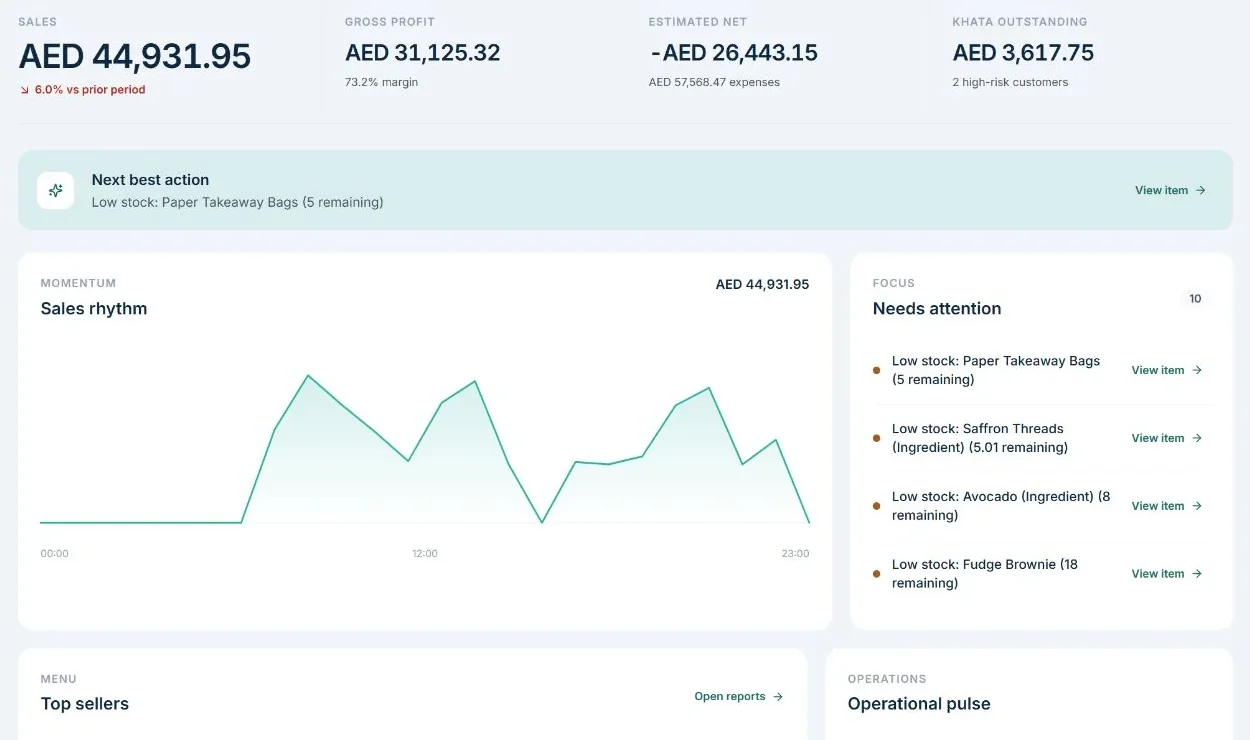
Khata outstandingDemonstration data
Product screens show demonstration data. Venue photos are illustrative.
Read the steps as text
Step 1: start from the khata aging report, which shows balances by how long they have been outstanding. Step 2: send the first reminder a day or two after the due date, with the exact amount and an easy way to pay. Step 3: follow up on a fixed rhythm, for example day 3, day 10 and day 21, and keep a note of each reminder. Step 4: if a balance keeps growing, lower the limit or pause new credit until it is settled, and watch total khata outstanding on the owner dashboard.
Why does email work so well for recovery in the UAE?
Because it reaches customers where they already are. In the UAE, email is the everyday channel - a reminder there gets seen, unlike a posted letter or a missed call. It's also low-pressure: a message can be read and acted on in the customer's own time, which feels far less confrontational than a phone call or a face-to-face ask. And every message is a timestamped record of what was sent and when.
| Channel | Reach | Pressure on customer | Record kept |
|---|---|---|---|
| Face-to-face | Low (only when in store) | High (awkward) | None |
| Phone call | Medium | High | Rarely |
| High (everyday channel) | Low (reply in own time) | Yes, full log |
When should I send reminders?
Tie reminders to the age of the balance, escalating gently in frequency (never in tone):
- 0-30 days: a light, friendly first reminder.
- 31-60 days: a slightly firmer but still warm follow-up.
- 61-90 days: more regular nudges, perhaps offering to arrange a settlement.
- 90+ days: prioritise - these are most at risk, and consistent contact is what rescues them.
Seeing the balance by age is what lets you chase the right customer at the right moment, instead of treating a one-week-late regular the same as a three-months-gone debt.
Read next: What is Khata and how do UAE shops use it? (pillar) · How to use email to chase customer credit · The risk of informal credit ledgers
Frequently asked questions
How do I recover overdue customer credit without damaging the relationship?
Use consistent, friendly reminders rather than confrontation. Start early, keep the tone warm, make it easy to pay, and stay regular. Automating reminders through email keeps the relationship intact while still chasing the money.
Why is email good for chasing payments in the UAE?
Because it reaches customers on the channel they already use every day, lets them respond in their own time so it feels low-pressure, and keeps a timestamped record of every reminder sent.
When should I start chasing an overdue balance?
Early - a gentle reminder a day or two after a balance is due is far easier and more effective than waiting a month. Escalate the frequency of reminders as a balance ages, but keep the tone friendly throughout.
How do I know which debts to prioritise?
Track balances by age. Debts past 90 days are most at risk and should be prioritised, while recent balances need only a light first reminder. An aging report shows you who to chase and how urgently.
About this guide. Maintained by the TajerGo Editorial Team. Last updated 26 Sep 2026. Worked examples use illustrative numbers, not customer results.